How to Choose a Standalone ECU for Your Race Car

Share:
Share:
By Andrius Kontrimas, Motorsport Engineer — Race Engineer in GT3, LMP3 and 24H Series. Founder of XTRA Motorsport.
There is one question that comes up at every build discussion, every tuner meeting, and every motorsport electronics conversation: which standalone ECU should I use? The answer is always the same — it depends. But “it depends” is only useful when you know what it depends on.
This guide covers every factor that actually matters when choosing a standalone engine management unit: what a standalone ECU does that your factory ECU cannot, how to count I/O before you buy, why your tuner’s choice matters more than any spec sheet, and how to think about the software ecosystem your ECU lives in.
Not every application needs a standalone ECU. There are three categories of engine management solution, and understanding the difference saves you from overspending — or from choosing a tool that limits your build.
| Solution | What it does | Best for | Limitations |
|---|---|---|---|
| OEM reflash | Modifies parameters inside the factory ECU | Mild power increase, road use, OEM hardware retained | Limited by OEM architecture; cannot add channels |
| Piggyback | Intercepts and modifies signals between sensors and OEM ECU | Interim solution, turbo conversions with budget constraints | Dual-ECU conflicts, limited motorsport functions |
| Plugin ECU | Replaces factory ECU using the OEM wiring connector | Supported OEM platforms — no harness modification required | Limited to specific engine/chassis combinations; plug-in variants not available for every platform |
| Wire-in ECU | Replaces factory ECU with a custom wiring harness | Any engine, custom installations, full motorsport builds | Requires a full custom harness and calibration from scratch |
You need a standalone ECU when:
The threshold varies by platform and build, but as a general rule: if the modification list is affecting how the engine breathes and burns, a reflash starts to become a compromise. Once you are running a custom cam profile, a standalone unit is almost always the correct answer.
A common misconception is that an ECU only manages fuelling and ignition. In a modern standalone, the ECU is the central data hub and control point for the entire powertrain and many chassis functions.
Modern standalone ECUs output data streams over CAN bus that are read by dash loggers, PDMs, ABS systems, and CAN keypads. The ECU becomes the source of truth for RPM, speed, engine temps, lambda, and fault codes — all carried on a single two-wire bus to every connected device.
Every ECU has a fixed number of input and output channels. Running out of channels after you have bought the ECU is an expensive mistake. Count your requirements before you start talking to dealers.
Sequential injection fires each injector individually at the correct crank angle. Count the number of cylinders. A 6-cylinder engine running sequential injection needs 6 injector outputs. Some ECUs support staged injection (two injectors per cylinder) — double that number.
Standard 0–5 V sensor signals. Count every sensor: – MAP sensor (manifold pressure / boost pressure — some builds use two) – TPS (throttle position) — DBW requires a redundant pair per throttle body – APS (accelerator pedal position) — DBW requires a redundant pair – Coolant temperature – Intake air temperature – Oil pressure – Oil temperature – Fuel pressure – Wheel speed sensors (typically 4 for traction control or ABS integration)
Crank and cam position sensors connect to dedicated trigger inputs, not analog channels. Count one per crank reluctor and one per cam — engines with variable valve timing on multiple cams need one per camshaft.
Knock sensors use a dedicated high-frequency input, separate from the analog input bank. Count one per cylinder bank minimum — a V8 needs two.
Modern ECUs provide dedicated wideband lambda inputs or read lambda over CAN from a standalone controller. These are not 0–5 V analog inputs. Count one per exhaust bank — a V8 or any engine requiring per-bank fuelling correction needs two.
Frequency-based or switched signals that are not analog: ethanol content sensor (flex fuel, frequency input), wheel speed sensors on some configurations, clutch switch, brake switch.
The 4G63 originally used a cable throttle. Converting to DBW adds four analog inputs straight away — the throttle body needs a redundant TPS pair (TPS 1 and TPS 2), and the accelerator pedal needs its own redundant pair (APS 1 and APS 2). This is why a build like this uses a wire-in ECU even though 4G63 plug-in units exist: the OEM connector was not designed for DBW and cannot support the additional channels without significant harness modification.
| Input type | Inputs | Count |
|---|---|---|
| Analog | APS 1 + APS 2 (pedal, redundant pair) | 2 |
| TPS 1 + TPS 2 (throttle body feedback, redundant pair) | 2 | |
| MAP — pre-throttle (boost pressure) | 1 | |
| MAP — post-throttle (manifold pressure / load) | 1 | |
| ECT (coolant temperature) | 1 | |
| IAT (intake air temperature) | 1 | |
| Oil pressure | 1 | |
| Oil temperature | 1 | |
| Fuel pressure | 1 | |
| Trigger | Crank position sensor | 1 |
| Cam position sensor (MIVEC intake cam) | 1 | |
| Dedicated knock | Knock sensor | 1 |
| Dedicated lambda | Wideband lambda controller | 1 |
| Digital | Ethanol content sensor (flex fuel, frequency input) | 1 |
| Total | 16 |
| Output type | Outputs | Count |
|---|---|---|
| Injector | Sequential — 4 cylinders | 4 |
| Ignition | Coil on plug — 4 cylinders | 4 |
| Auxiliary | DBW Motor+ | 1 |
| DBW Motor− | 1 | |
| DBW Relay (safety cut — omit if using PDM) | 1 | |
| VVT solenoid (MIVEC intake cam) | 1 | |
| Boost solenoid | 1 | |
| Total aux | 5 (or 4 with PDM) |
A mid-range wire-in ECU handles this comfortably. The injector and ignition outputs are dedicated channels — the 5 auxiliary outputs are what determines whether a base or mid-range unit is sufficient.
The S65 is naturally aspirated — no boost control needed — but the combination of dual throttle bodies (one per bank of four cylinders) and quad VANOS (variable timing on all four camshafts, both intake and exhaust on both banks) puts this engine among the highest I/O requirements of any road-derived engine.
Each throttle body has its own motor and its own redundant TPS pair. Each camshaft has its own position sensor. Each bank needs its own wideband lambda input and knock input.
| Input type | Inputs | Count |
|---|---|---|
| Analog | APS 1 + APS 2 (pedal, dual signal) | 2 |
| TPS 1 + TPS 2 (left bank throttle body, redundant) | 2 | |
| TPS 3 + TPS 4 (right bank throttle body, redundant) | 2 | |
| MAP — left bank | 1 | |
| MAP — right bank | 1 | |
| ECT, IAT, oil pressure, oil temperature, fuel pressure | 5 | |
| Trigger | Crank position sensor | 1 |
| Cam sensor × 4 (one per camshaft, quad VANOS) | 4 | |
| Dedicated knock | Knock sensor — left bank + right bank | 2 |
| Dedicated lambda | Wideband lambda — left bank + right bank | 2 |
| Total | 22 |
| Output type | Outputs | Count |
|---|---|---|
| Injector | Sequential — 8 cylinders | 8 |
| Ignition | Coil on plug — 8 cylinders | 8 |
| Auxiliary | DBW Motor+ — left bank | 1 |
| DBW Motor− — left bank | 1 | |
| DBW Relay — left bank (omit with PDM) | 1 | |
| DBW Motor+ — right bank | 1 | |
| DBW Motor− — right bank | 1 | |
| DBW Relay — right bank (omit with PDM) | 1 | |
| VANOS solenoid × 4 (intake L, intake R, exhaust L, exhaust R) | 4 | |
| Total aux | 10 (or 8 with PDM) |
This is high-spec ECU territory. The S65 requires an ECU with dedicated H-bridge outputs for each throttle motor, sufficient trigger inputs for five position sensors, and dual lambda inputs — not a combination that any mid-range unit satisfies without CAN expansion.
The PSA EP6 1.6T is the Prince engine used in WRC2 and R5 rally programmes and in circuit builds across Europe. It is a turbocharged four-cylinder with direct injection (GDI) and intake cam VVT. Direct injection changes the I/O count in two specific ways compared to a port injection engine of the same cylinder count: it adds two fuel pressure inputs (low-pressure pre-pump and high-pressure rail), and it requires a dedicated solenoid output to control the cam-driven high-pressure fuel pump (HPFP). The injectors themselves require high-voltage peak-and-hold drivers — standard port injection driver circuits will not fire GDI injectors correctly.
This is the application the MoTeC M142 is built for.
| Input type | Inputs | Count |
|---|---|---|
| Analog | APS 1 + APS 2 (pedal, redundant pair) | 2 |
| TPS 1 + TPS 2 (throttle body, redundant pair) | 2 | |
| MAP — pre-throttle (boost pressure) | 1 | |
| MAP — post-throttle (manifold pressure / load) | 1 | |
| ECT (coolant temperature) | 1 | |
| IAT (intake air temperature) | 1 | |
| Oil pressure | 1 | |
| Oil temperature | 1 | |
| LP fuel pressure (low-pressure side, pre-HPFP) | 1 | |
| HP fuel pressure (direct injection rail, 50–200 bar) | 1 | |
| Trigger | Crank position sensor | 1 |
| Cam position sensor (intake VVT) | 1 | |
| Dedicated knock | Knock sensor | 1 |
| Dedicated lambda | Wideband lambda | 1 |
| Digital | Ethanol content sensor (flex fuel, if applicable) | 1 |
| Total | 17 |
| Output type | Outputs | Count |
|---|---|---|
| Injector | Sequential GDI — 4 cylinders (high-voltage peak-and-hold) | 4 |
| Ignition | Coil on plug — 4 cylinders | 4 |
| Auxiliary | DBW Motor+ | 1 |
| DBW Motor− | 1 | |
| DBW Relay (omit with PDM) | 1 | |
| VVT solenoid (intake cam) | 1 | |
| Boost control solenoid | 1 | |
| HPFP control solenoid (high-pressure fuel pump) | 1 | |
| Total aux | 6 (or 5 with PDM) |
The channel count is similar to the port injection 4G63 example, but the ECU requirements are fundamentally different. A standard port injection ECU cannot drive GDI injectors. The high-voltage injection circuit, the dual fuel pressure monitoring (both LP and HP sides), and the HPFP solenoid control are specific to direct injection hardware — and the reason why GDI builds require an ECU with dedicated GDI support rather than a standard wire-in unit.
Many peripheral devices communicate over CAN rather than needing dedicated wiring back to the ECU. A PDM, ABS unit, or CAN keypad connected via CAN reduces discrete wiring significantly. When comparing ECUs, look at both the direct I/O count and the CAN expansion capability — these together determine the true channel capacity of the system.
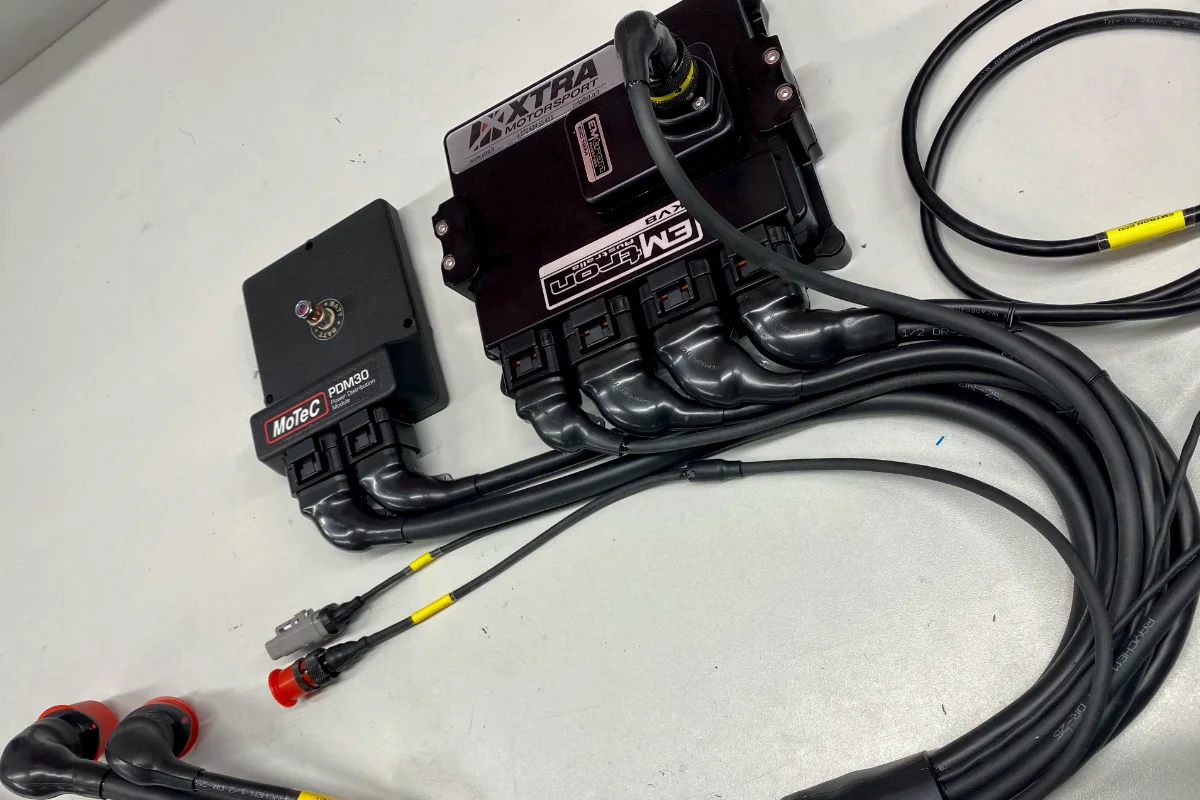
Every competent ECU brand produces hardware that can make good power and run reliably. The difference between a good tune and a bad one is almost never the ECU — it is the tuner’s depth of knowledge of that specific platform.
A tuner who has spent years working in a particular ECU’s calibration software knows: – Where the map resolution needs to be high and where it can be coarse – How the knock detection algorithm responds and how to set the threshold correctly – Which combination of fuel model settings gives stable closed-loop behavior at idle without hunting – How to configure the launch control so it is consistent across a range of track temperatures
A mid-range ECU with an expert tuner will outperform an advanced ECU with a novice every time. Before you choose hardware, ask which ECU brands the tuners you trust work with regularly.
Remote tuning is increasingly common on platforms like Emtron, where the calibration file can be sent, loaded by the owner, and data logs reviewed remotely. This changes the economics of tuning for imported builds or cars that cannot easily reach a dyno.
An ECU does not operate in isolation. In any properly built motorsport electronics system, the ECU shares data with: – A dash logger (speed, RPM, temperatures, lambda, fault display) – A PDM (power distribution — the ECU triggers outputs via CAN rather than discrete wiring) – An ABS unit (the ECU reads wheel speeds and may control brake intervention) – CAN keypads (the driver controls launch control, ABS mode, fan, boost from a single keypad)
The question of whether an ECU uses an open CAN protocol (its data frames are documented and mappable by any third-party device) or a closed protocol (proprietary, works only within the same brand’s ecosystem) determines how freely you can build your system.
Emtron KV series transmits RPM, TPS, coolant temp, lambda, gear position, and fault codes on a documented CAN stream. An AiM MXS dash logger reads this stream directly using a preloaded Emtron template. A Blink Marine CAN keypad receives its enable signals from the ECU via CAN. A PDM monitors the same stream to control fan relays and fuel pump conditionally on coolant temp and engine state. Every device is from a different manufacturer, and they all share one two-wire CAN bus.
Bosch Motorsport takes a different approach. The MS6 ECU and DDU dash/data logger communicate with each other over Automotive Ethernet (100Base-T1) — a higher-bandwidth link than CAN that handles the data volumes required for professional logging and real-time display. Peripheral Bosch devices such as the ABS M5 and PBX keypad connect via CAN, but each to a single Bosch unit (typically the ECU) rather than independently to every device on the network. The practical benefit is the RaceCon project environment: all Bosch components are configured in one project file, and cross-device signal routing is handled automatically — no manual CAN frame mapping between each device pair. Third-party devices connect to the Bosch ecosystem via CAN in the standard way.
Neither architecture is wrong — choose based on which other devices you are already committed to. The mistake is buying an ECU without knowing which devices it needs to talk to, and whether the protocol is documented for third-party integration.
XTRA Motorsport stocks Emtron and Link ECU. Bosch Motorsport ECUs and MoTeC are supplied to order. MaxxECU and Ecumaster are listed here for reference — these are platforms our customers ask about, and an honest comparison requires covering them.
All I/O figures are from official datasheets or manufacturer specifications.
All three KV variants share the same input architecture: 16 dedicated analog inputs (0–5 V), of which 6 have selectable pullup for temperature sensors — no separate temp input bank. 14 digital inputs that can also be configured as analog inputs (0–20 V, 10-bit, 4.88 mV resolution); 8 of these are frequency-capable, all 14 are switched inputs. KV16M is a separate variant with 24 analog inputs.
| ECU | Inj | Ign | Analog | Digital | Knock | Lambda | CAN | Price tier |
|---|---|---|---|---|---|---|---|---|
| Emtron KV8 | 8 | 8 | 16 | 14 (8 freq.) | 2 | 2× onboard LSU4.9 | 2 | ●●●● |
| Emtron KV12 | 12 | 12 | 16 | 14 (8 freq.) | 2 | 2× onboard LSU4.9 | 2 | ●●●● |
| Emtron KV16 | 16 | 16 | 16 | 14 (8 freq.) | 2 | 2× onboard LSU4.9 | 2 | ●●●● |
| Emtron Shadow 8 | 8 | 8 | 10 | 10 | 2 | External ECL1/2 | 2 | ●●○○ |
| Bosch MS6.1 EVO | 12 LP | 12 | 21 (+17 opt.) | 18 | 2 | 2× onboard LSU4.9 | 2× ETH + 3× CAN | ●●●● |
| Bosch MS6.2 EVO | 12 LP | 12 | 38 | 10 | 2 | 2× onboard LSU4.9 | 2× ETH + 3× CAN | ●●●● |
| Bosch MS6.3 EVO | 8 HP + 12 LP | 12 | 21 (+17 opt.) | 18 | 2 | 2× onboard LSU4.9 | 2× ETH + 3× CAN | ●●●● |
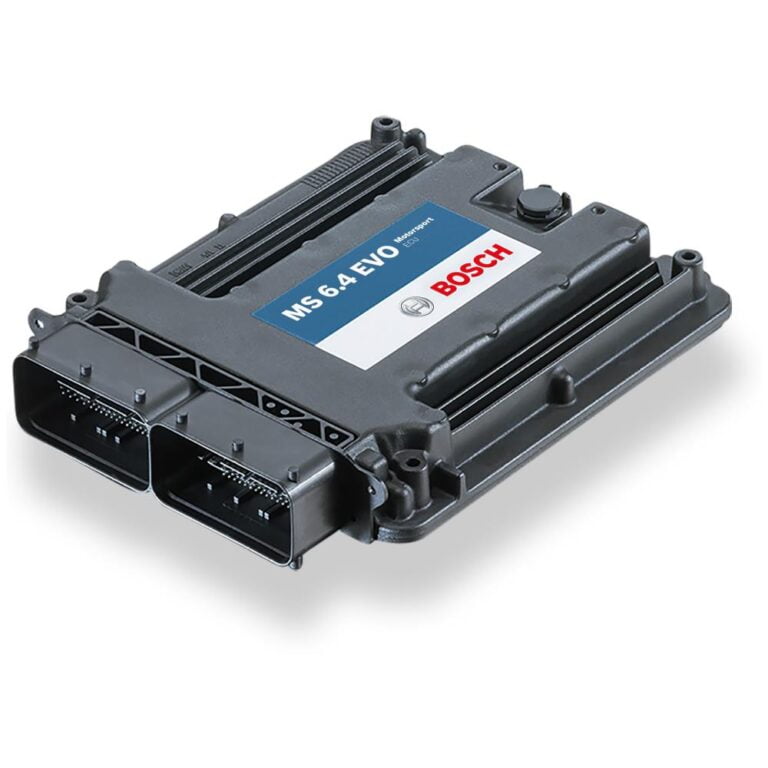
| Bosch MS6.4 EVO | 8 HP + 12 LP | 12 | 38 | 10 | 2 | 2× onboard LSU4.9 | 2× ETH + 3× CAN | ●●●● |
| MoTeC M142 | 8 DI + 6 LS | 8 | 23 (17 + 6 temp) | 16 | 4 | External — LTC/LTCD via CAN | 3 | ●●●● |
| MoTeC M150 | 12 PH | 12 | 21 (17 + 4 temp) | 16 | 4 | 2× NB onboard / CAN wideband | 3 | ●●●● |
| Link G4X FuryX | 8 | 6 | 15 (11 + 4 temp) | 8 | 2 | Built-in (FuryX) | 2 | ●●●○ |
| Link G5 Voodoo Pro | 16 | 12 | 18 (14 + 4 temp) | 10 | 2 | 2× onboard | 2 | ●●●○ |
| MaxxECU Race | 8 | 8 | 8 (6 + 2 temp) | 6 | 2 | Dual built-in | 2 | ●●●○ |
| Ecumaster EMU Black | 6 (8†) | 6 | 9 | 3 | 2 | Built-in LSU4.2 | 1 | ●●○○ |
| Ecumaster EMU PRO-8 | 8 | 8 | 14 (10 + 4 EGT) | 8 | 2 | 2× onboard LSU4.9 | 2 | ●●●○ |
† Up to 8 HiZ injectors sequential via 6 outputs. G5 Voodoo Pro: 4 pins are shared multi-purpose (inj/ign/aux) — 16 inj and 12 ign are the maximum configurations, not simultaneous. EMU PRO-8 digital input count derived from published total of 24 inputs.
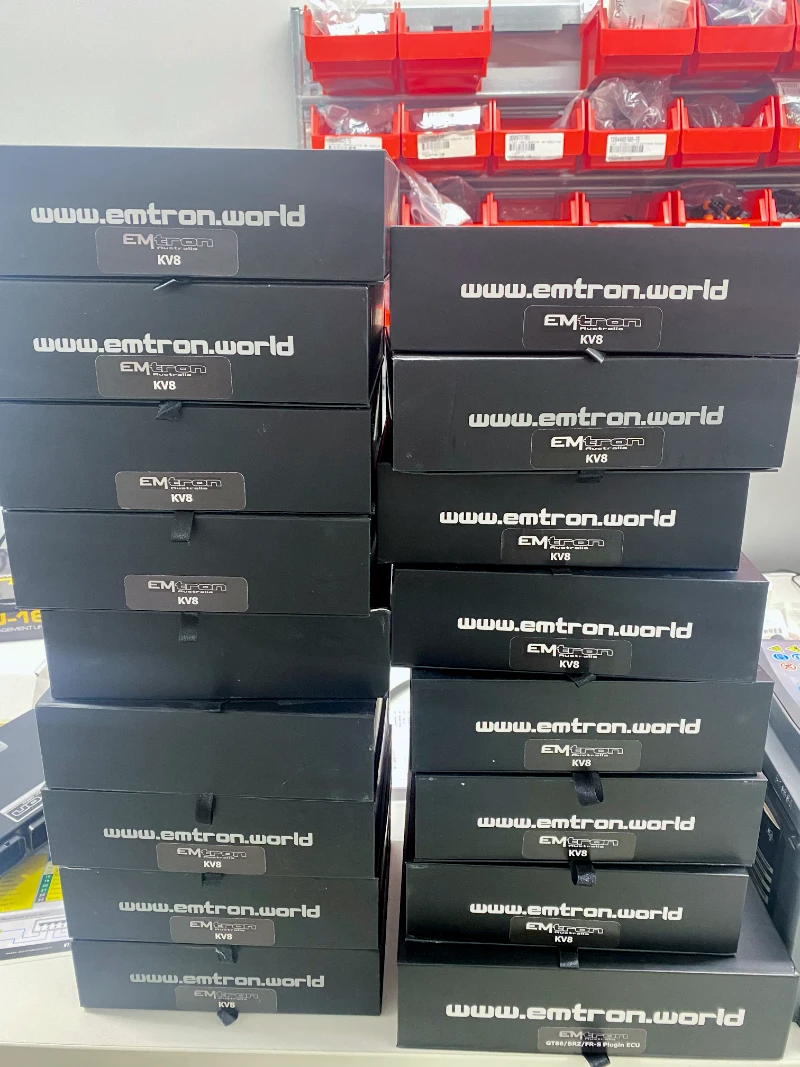
XTRA Motorsport’s primary ECU range and the platform we know best. The KV8 has been used on over 20 S65 V8 race car builds, handling quad VANOS, dual DBW, and dual lambda without requiring CAN expansion. The 14 digital inputs that accept 0–20 V analog signals are particularly useful for motorsport sensors with non-standard output ranges. Calibration software (Emtune) rewards time investment with precise control over every engine function. KV12 and KV16 scale the same architecture for higher cylinder counts. Full specifications and firmware release notes at emtronaustralia.com.au.
8-cylinder capable ECU at a step below the KV series. 10 analog inputs, 10 digital inputs, 12 auxiliary outputs, 2 knock inputs, and integrated GDI pump logic control on Aux 11/12 for direct injection applications. DBW is handled on Aux 9/10. Unlike the KV series, the Shadow 8 has no built-in lambda inputs — lambda requires an external Emtron ECL1 or ECL2 controller connected via CAN.
Four variants, each with 12 ignition outputs and up to 12 injector outputs. The MS6.1 and MS6.2 are for port injection engines. The MS6.3 and MS6.4 add 8 high-pressure GDI injector outputs and 2 HPFP control channels for direct injection, while retaining 12 low-pressure outputs for staged or port injection. The .1 and .3 have 21 built-in analog inputs expandable to 38 with the optional measurement package; the .2 and .4 have 38 analog inputs built-in. All variants connect via 2× Ethernet and 3× CAN — ECU to DDU over Ethernet, peripheral devices via CAN to a single host unit, all managed in one RaceCon project. Supplied to order. See the full MS6 range at bosch-motorsport.de.
MoTeC’s ECU for direct injection race engines. 8 direct injector outputs (high-voltage peak-and-hold) plus 6 low-side injector outputs for staged or port injection, 8 ignition outputs, 17 analog inputs, 6 temperature inputs, 4 knock inputs, 16 digital inputs (12 universal + 4 dedicated), 10 half-bridge auxiliary outputs, and 3 CAN buses. Used on engines including the PSA EP6 1.6T in WRC2 and R5 rally builds. CAN protocol capabilities depend on the firmware in use — MoTeC’s own firmware, GPR (Generic Protocol), or third-party firmware each have different CAN configuration options. Confirm with your tuner which firmware they intend to use before assuming CAN compatibility with third-party devices. MoTeC is a Bosch company. Supplied to order. Full documentation at motec.com.au.
MoTeC’s most capable race ECU in the M1 series. 12 peak-and-hold injector outputs, 12 ignition outputs, 17 analog inputs, 4 temperature inputs, 16 digital inputs, 4 knock inputs, 10 half-bridge auxiliary outputs, and 6 low-side auxiliary outputs. Suits high-cylinder, multi-throttle, and high-channel-count race programmes where the M142 runs short. Lambda is external via CAN — the 2 built-in narrowband inputs are for OEM-style closed-loop, not motorsport wideband control. CAN protocol considerations are identical to the M142: confirm the firmware configuration with your tuner before assuming third-party device compatibility. 250 MB internal data logging as standard. Supplied to order.
8 injector outputs, 6 ignition outputs, 11 analog + 4 temperature inputs, 8 digital inputs, 2 knock inputs, 10 auxiliary outputs. The X variant includes built-in digital wideband lambda. Broad plug-in range covering many popular platforms (Subaru, Mitsubishi, Honda, Nissan, Toyota). PC Link software is approachable and tuner availability across Europe is strong.
16 injector outputs, 12 ignition outputs (4 pins shared multi-purpose — inj, ign, or aux), 14 analog + 4 temperature inputs, 10 digital inputs, 2 knock inputs, 14 auxiliary outputs, 2 onboard wideband lambda channels, dual H-bridge for E-throttle, 2 CAN buses. Supports port injection and direct injection simultaneously. Built-in GPS to 50 Hz. The G5 generation connects to the calibration laptop via WiFi or USB-C and runs dual microcontrollers — one for engine management, one for communications.
8 injector and 8 ignition outputs, 6 analog + 2 temperature inputs, 6 digital inputs, 2 knock inputs, dual built-in wideband lambda, 2 CAN buses, 9 low-side + 2 high-side auxiliary outputs. Strong following in Europe for VAG, BMW, and Volvo applications with good plugin coverage. Open CAN with a growing third-party template library.
Ecumaster’s current-generation platform, a significant step above the EMU Black. 8 peak-and-hold injector outputs with integrated low-impedance drive, dual built-in LSU4.9 wideband lambda (expandable to 4 sensors), dual DBW with auto-calibration, up to 4 VVT channels, and sequential gearbox control built-in. 2 CAN buses plus LIN. 14 analog inputs including 4 EGT-capable high-precision channels. The EMU PRO uses the same CAN data structure as the EMU Black for backward compatibility with existing templates and dash configurations. Strong tuner coverage across Europe, particularly on VAG, BMW, and Volvo applications.
Browse the full standalone ECU range — Emtron KV and Shadow series, Link G4X and G5, with Bosch Motorsport and MoTeC available to order.
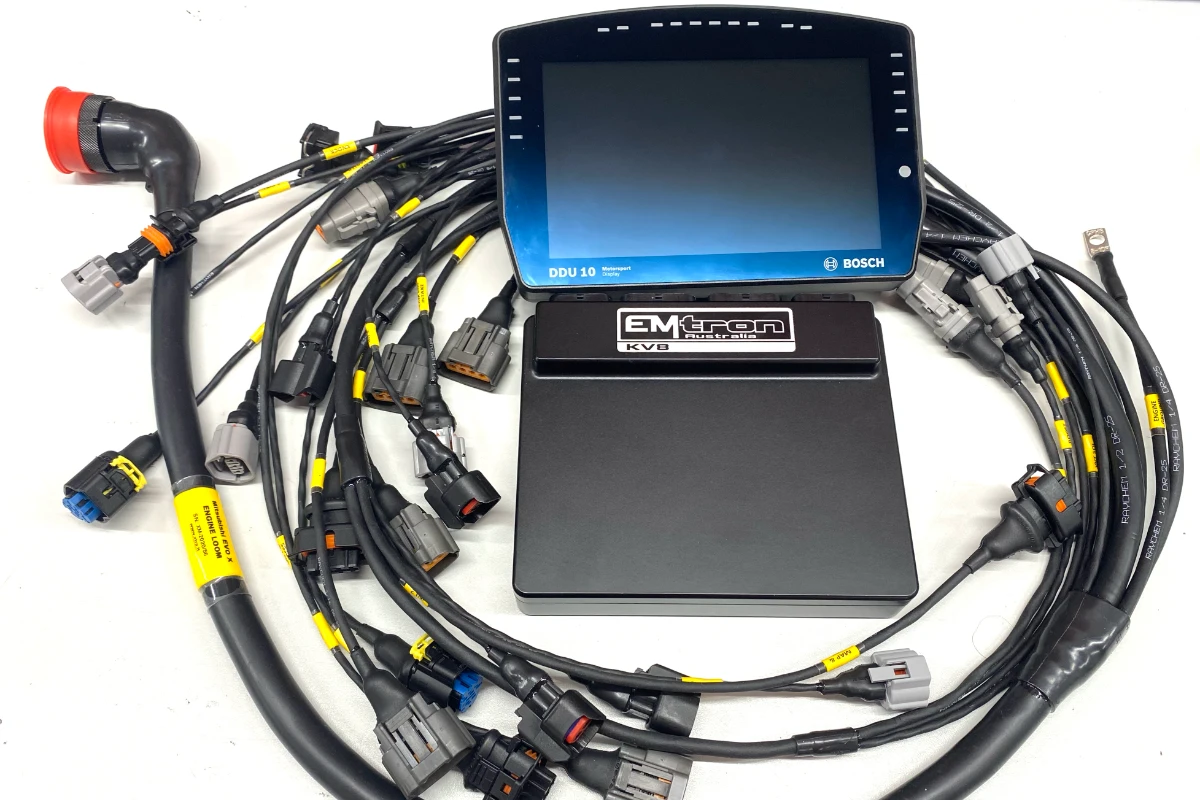
For builds where the engine is in its original chassis with the OEM wiring intact, a plugin ECU replaces the factory unit using the OEM connector. The factory injector wiring, ignition wiring, and sensor loom remain in place. No custom harness is required.
The cost and time difference is significant. A plugin installation on a supported platform can be completed in a day. A wire-in installation on the same engine requires a complete custom harness — typically a week of skilled labour on top of materials.
Plugin ECUs are available for many popular platforms: Subaru EJ series, Mitsubishi 4G63 and 4B11, Honda K and B series, Toyota 2JZ and 1JZ, Nissan RB and SR series, and a growing range of VAG and BMW applications. If your engine is on the supported list and the build does not require additional channels, the plugin route is the most efficient path to a standalone tune.
The 4G63 example in this guide illustrates the boundary. A plugin 4G63 ECU exists and works on a stock-connector build. The moment you convert to DBW, you need four additional analog inputs (APS 1, APS 2, TPS 1, TPS 2) that the OEM connector was not designed to carry. A wire-in ECU becomes the cleaner solution.
The same applies to any significant addition: wheel speed sensors for traction control, an ethanol content sensor for flex fuel, or a PDM requiring dedicated CAN wiring. Once the OEM connector cannot carry the required channels, the cost advantage of a plugin disappears.
| Scenario | Recommendation |
|---|---|
| Stock engine, stock chassis, power tune only | Plugin ECU |
| Additional sensors required (ethanol, wheel speed) | Wire-in |
| DBW conversion | Wire-in |
| Engine swap or custom installation | Wire-in |
| Full motorsport build with PDM and CAN devices | Wire-in |
| Regulated series requiring specific ECU hardware | Per series rules |
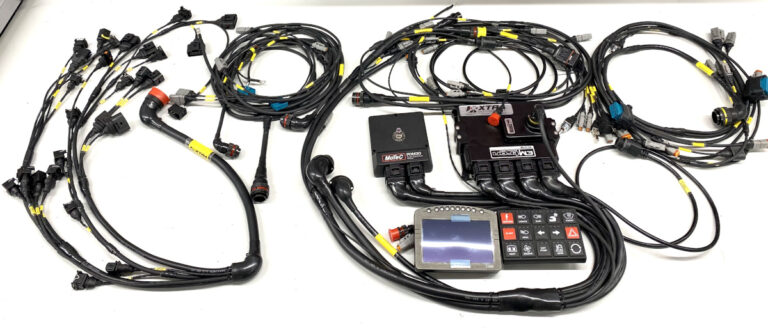
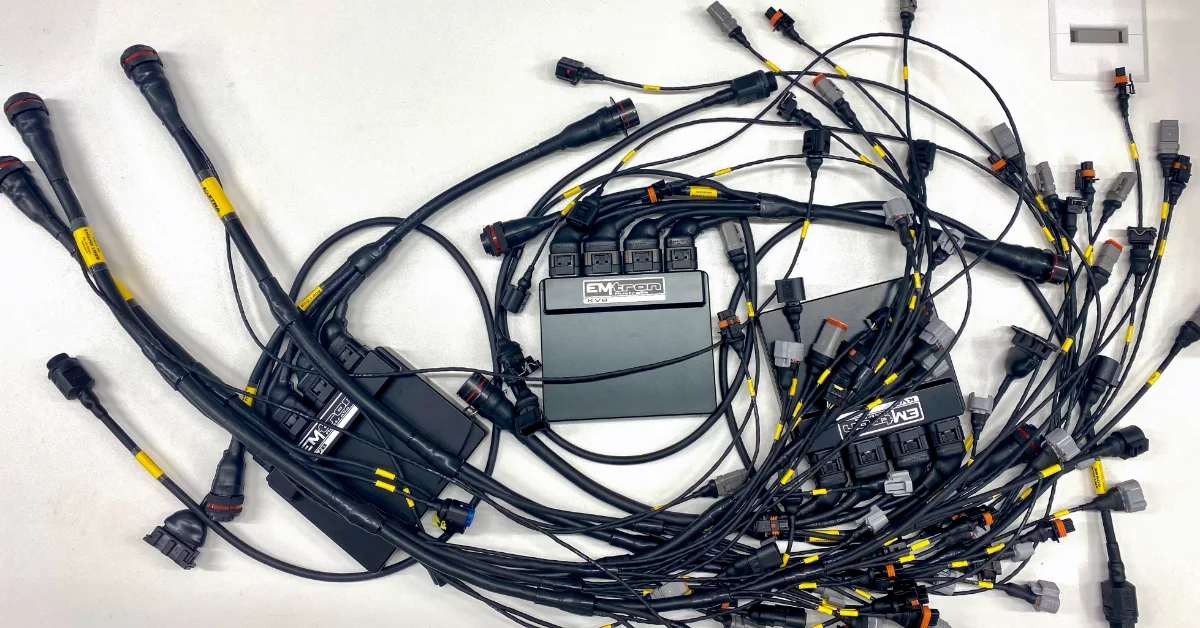
A wire-in standalone ECU replaces the factory engine management — which means it also replaces the factory wiring strategy. You will need a custom harness.
This is not optional, and it is not cheap. A professional motorsport harness built to mil-spec M22759/32 Tefzel wire, with Deutsch DT or Autosport connectors and Raychem DR-25 heat shrink protection, typically costs as much as the ECU itself — and on complex builds with PDM integration, multiple CAN devices, and a separate sensor loom, the harness cost regularly exceeds the ECU.
Plan the harness budget before you buy the ECU. The build total is: ECU + harness materials + build labour + calibration. Anyone who quotes you an ECU price without mentioning harness cost is giving you an incomplete picture.
See the motorsport wiring category for the wire, heat shrink, and boots used in professional harness construction, and read our full guide on how to build a motorsport wiring loom for the detail on materials and technique.
Before committing to a standalone ECU, run through this checklist:
1. Which ECU does my tuner know? This is the first question, not the last. The right ECU for your build is almost always the one your tuner has the most hours in. Ask before you buy.
2. Have I counted my I/O? List every injector, coil, sensor, and CAN device. Add them up. Compare against the ECU’s channel count with 20% headroom for future changes.
3. What other devices does this ECU need to talk to? Dash, PDM, ABS, keypad — list them. Confirm that the ECU you are considering has a documented CAN stream or has pre-built templates for those devices.
4. Is a plug-in available for my engine? If your engine is in its original chassis with OEM wiring intact, a plug-in variant may save significant harness work. Coverage varies by brand — check which ECU manufacturers offer a plug-in for your specific engine and chassis combination before committing to wire-in.
5. What is the total build cost including harness and calibration? Get a full quote: ECU, harness (materials + build labour), and dyno time. If you are planning remotely, add the tuner’s remote support cost. The ECU is often the smallest line item in this total.