CAN Devices
CAN bus expansion modules extend the I/O capability of an ECU, PDM, or dash logger without running additional analogue wiring. Each device connects to the vehicle’s CAN network, reads a sensor or switch input locally, and broadcasts the data as a CAN message — which any CAN-capable device on the bus can receive. This approach reduces wire count, avoids long analogue signal runs that are susceptible to interference, and allows a single physical sensor to feed multiple control devices simultaneously.
XTRA Motorsport stocks CAN expansion devices from Emtron and Ecumaster covering wideband lambda, exhaust gas temperature, analogue I/O expansion, GPS, and panel-mounted switch inputs.
CAN Device Summary
| Device | Function | Channels | Output |
|---|---|---|---|
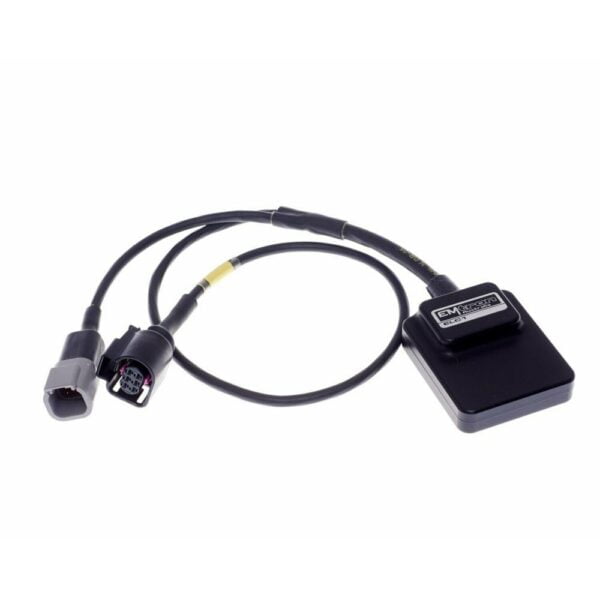
| Emtron ELC1 CAN Lambda Controller | Wideband lambda | 1 × LSU 4.9 | CAN |
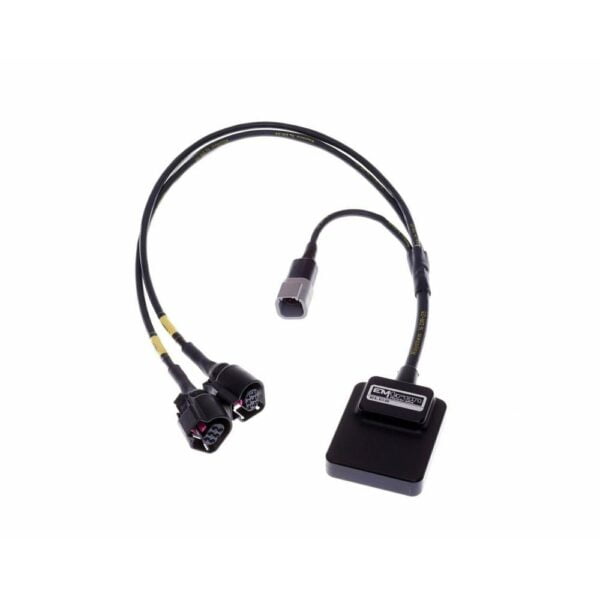
| Emtron ELC2 CAN Lambda Controller | Wideband lambda | 2 × LSU 4.9 | CAN |
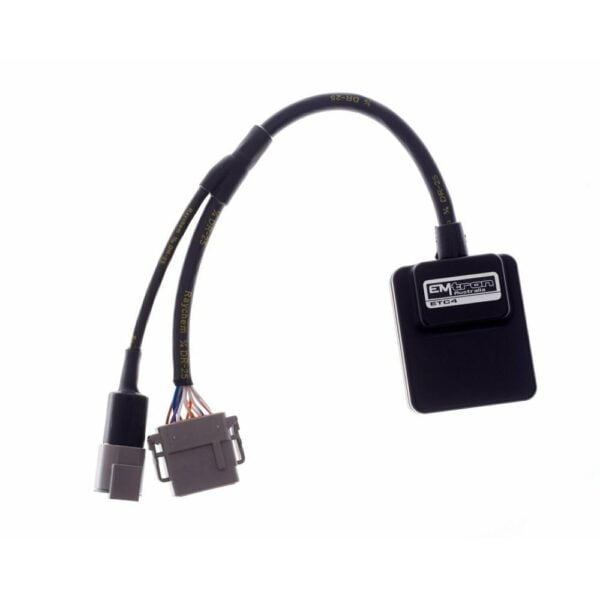
| Emtron ETC4 CAN EGT Controller | EGT (K-type thermocouple) | 4 channels | CAN |
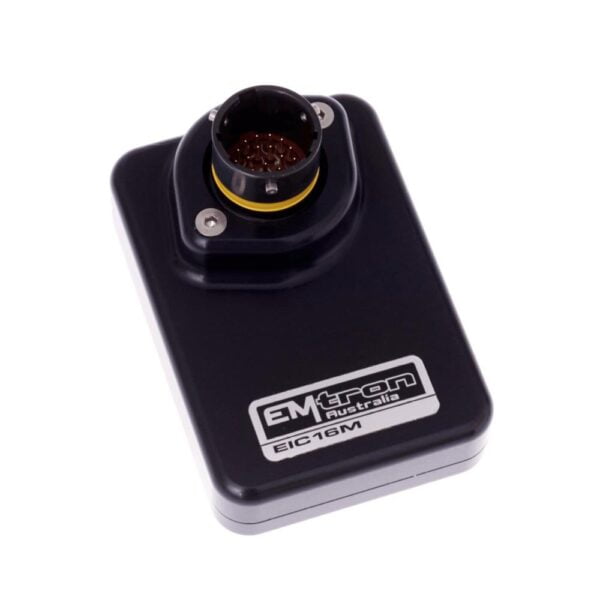
| Emtron CAN Device EIC16M | Analogue/digital I/O expander | 16 inputs + 4 outputs | CAN |
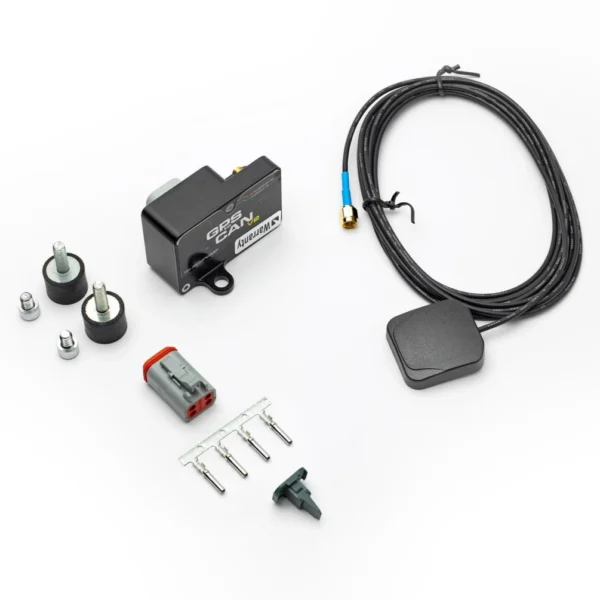
| Ecumaster GPS CAN V2 | GPS position, speed, heading | 10 Hz | CAN |
| Ecumaster CAN Switch Board V3 | Panel switch inputs | 12 positions | CAN |
Lambda Controllers
Emtron ELC1 — Single Channel
The Emtron ELC1 CAN Lambda Controller drives a Bosch LSU 4.9 wideband sensor and transmits air-fuel ratio data over CAN. It operates independently of any specific ECU brand — any ECU with a CAN input can receive the lambda value. This is the standard single-cylinder or single-exhaust solution for engines running one lambda sensor.
Emtron ELC2 — Dual Channel
The Emtron ELC2 CAN Lambda Controller drives two independent LSU 4.9 sensors simultaneously. Each channel outputs its own CAN message, allowing independent per-bank closed-loop fuelling on V-engines, twin-scroll turbocharged engines, or multi-cylinder engines with separate exhaust banks.
EGT Controllers
The Emtron ETC4 CAN EGT Controller reads four K-type thermocouples (0–1200 °C range) and transmits all four exhaust gas temperature values over CAN. It handles the cold-junction compensation and linearisation internally — the ECU or dash receives calibrated temperature values directly with no additional processing required. Suitable for cylinder-by-cylinder EGT monitoring on four-cylinder engines, or per-bank monitoring on larger engines.
I/O Expanders
The Emtron CAN Device EIC16M adds 16 analogue or digital input channels and 4 output channels to any CAN-connected system. Typical applications include measuring multiple pressure sensors, monitoring auxiliary temperatures, reading switch states, and controlling solenoids or relays from CAN commands — all through a single two-wire CAN connection back to the ECU or PDM.
GPS Modules
The Ecumaster GPS CAN V2 is a 10 Hz GPS receiver that transmits vehicle speed, position, and heading over CAN. It allows an ECU or PDM to use GPS-derived speed as a reference — useful for traction control, launch control, or as a speed source independent of wheel speed sensors. When connected to a dash logger with GPS lap timing, the same module feeds both the ECU logic and the data system.
CAN Switch Panels
The Ecumaster CAN Switch Board V3 houses 12 panel-mount switch positions and transmits all button states over CAN. The ECU or PDM maps each button to a function in software — map switching, launch mode selection, traction control level adjustment, fan override. Physical button changes are broadcast on the bus and acted on by whichever device is configured to respond, without dedicated signal wires from panel to each device.
Choosing a CAN Device by Application
| Application | Device |
|---|---|
| AFR monitoring, ECU-independent lambda | Emtron ELC1 |
| Dual-bank or V-engine lambda | Emtron ELC2 |
| Per-cylinder EGT, 4-cylinder | Emtron ETC4 |
| Extra analogue sensor inputs | Emtron EIC16M |
| GPS speed / traction control reference | Ecumaster GPS CAN V2 |
| Programmable switch panel | Ecumaster CAN Switch Board V3 |
FAQ
What is a CAN bus expansion module and why use one instead of direct wiring?
A CAN expansion module reads a sensor or switch locally and transmits the data as a CAN message. Any CAN-capable device on the bus — ECU, dash, PDM — can receive that message without individual signal wires running back to each device. This reduces harness complexity, eliminates long analogue signal runs susceptible to noise, and allows multiple devices to share a single sensor’s data simultaneously.
Will these CAN devices work with any ECU brand?
Yes, for ECUs that support configurable CAN receive channels. All Emtron and Ecumaster CAN devices transmit standard CAN 2.0B frames. The user configures the ECU’s CAN receive table to map the correct message ID and byte position to the appropriate channel — this is supported in Emtron, ECUmaster EMU, Link ECU, MoTeC, and most other professional ECU software. Consult your ECU’s CAN configuration documentation for the specific setup steps.
Can I run multiple CAN devices on the same bus as my ECU and dash logger?
Yes. CAN bus supports multiple nodes on a single two-wire network. All devices must share the same baud rate (typically 1 Mbit/s in motorsport applications) and each must have a unique message ID. Termination resistors (120 ohm) must be fitted at both physical ends of the bus — not at every node. Most ECUs and dash loggers have internal termination that can be enabled or disabled.
Do the Emtron lambda controllers work with non-Emtron ECUs?
Yes. The ELC1 and ELC2 transmit lambda values over CAN as standard CAN frames, independently of the ECU brand. They are not restricted to Emtron ECU hardware. The Emtron ECU software does include pre-configured receive templates for ELC1/ELC2 that simplify setup, but any ECU with a CAN receive table can be manually configured to read the same messages.
Showing all 7 results