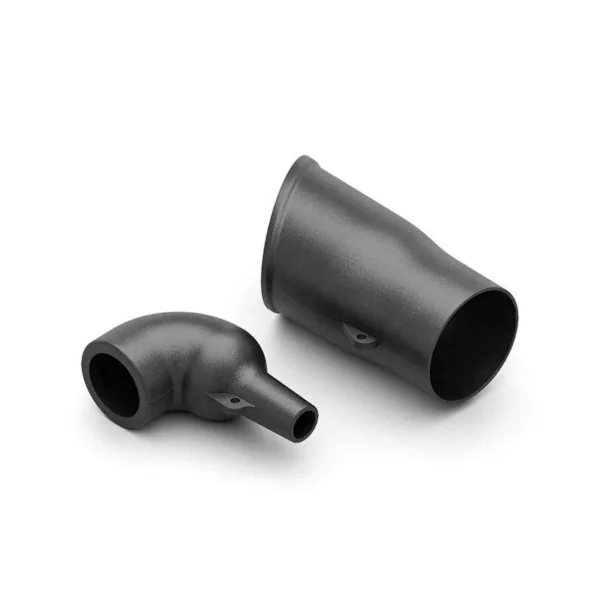
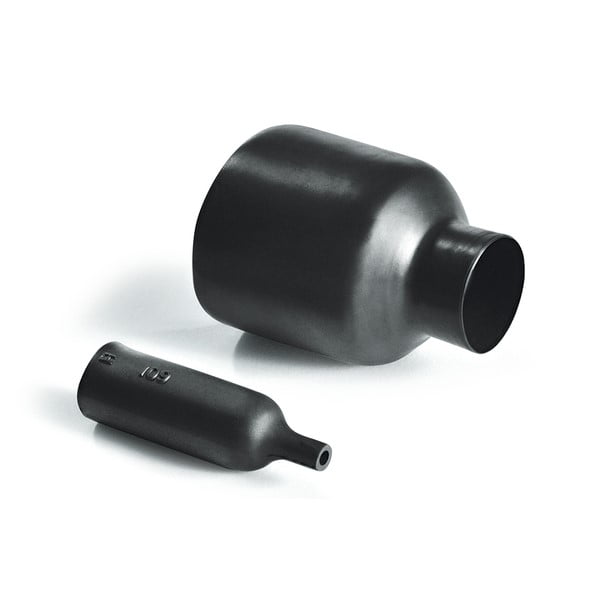
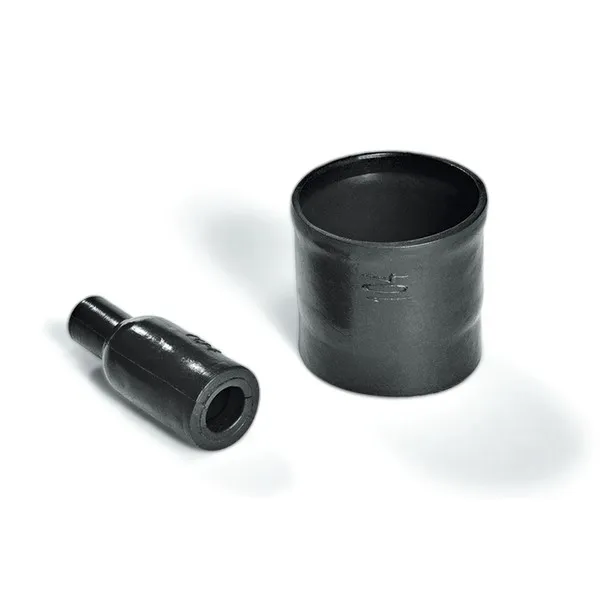
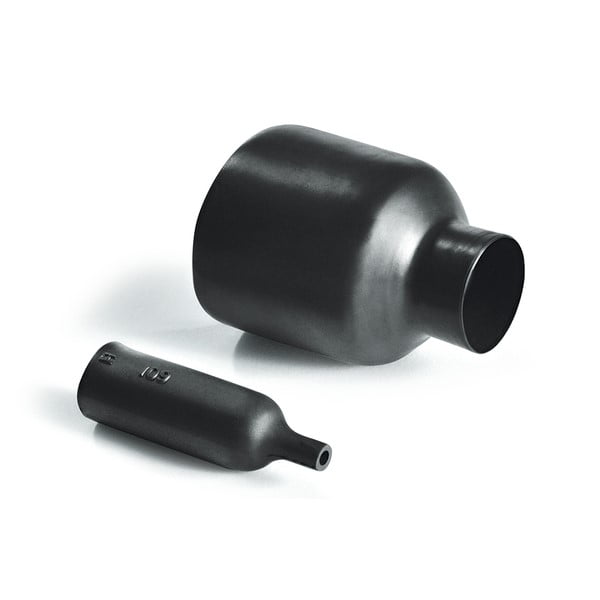
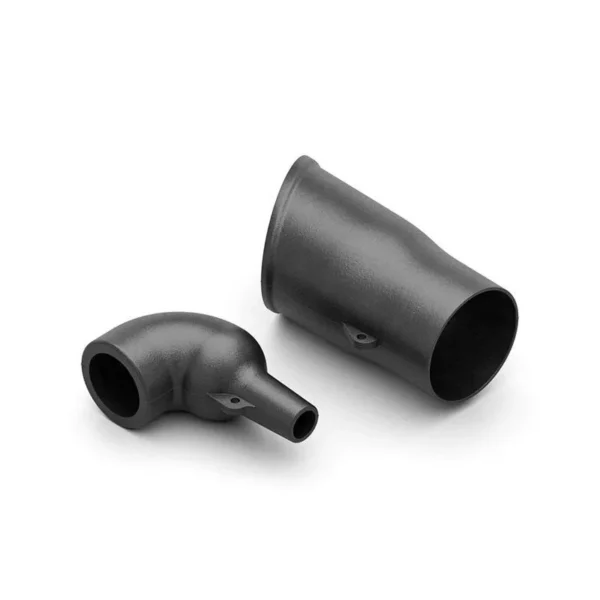
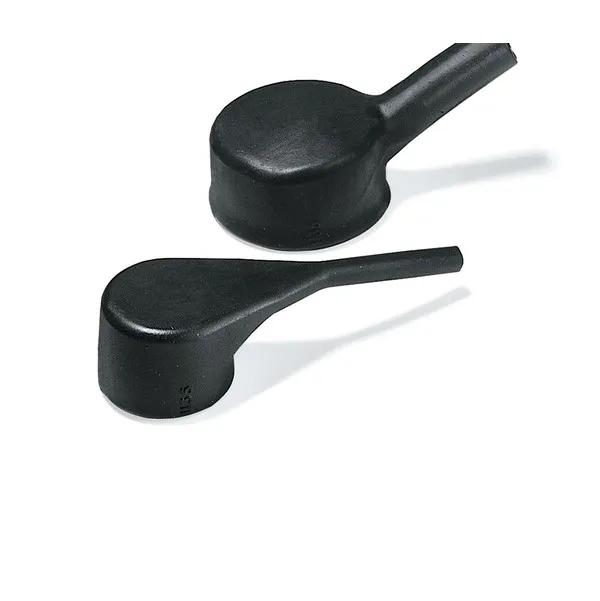
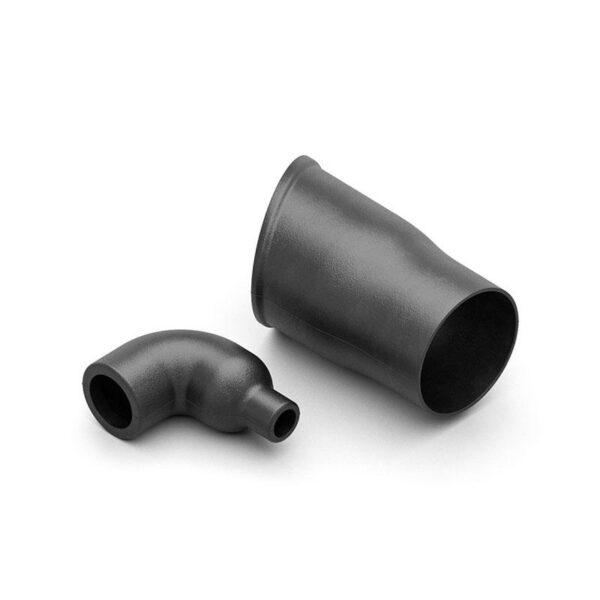
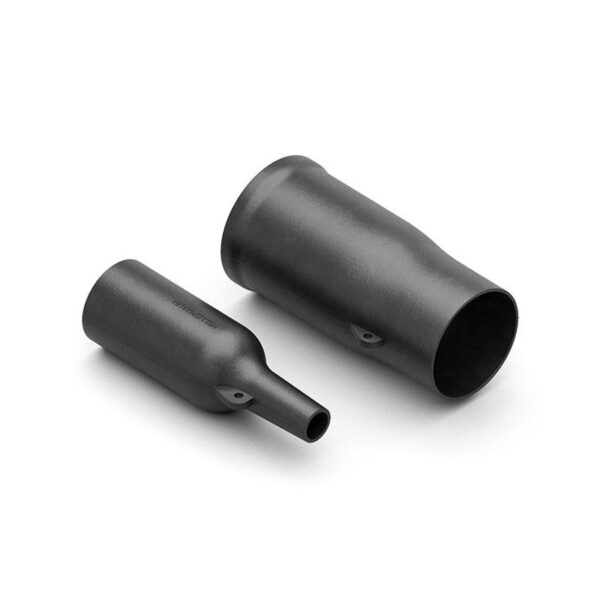
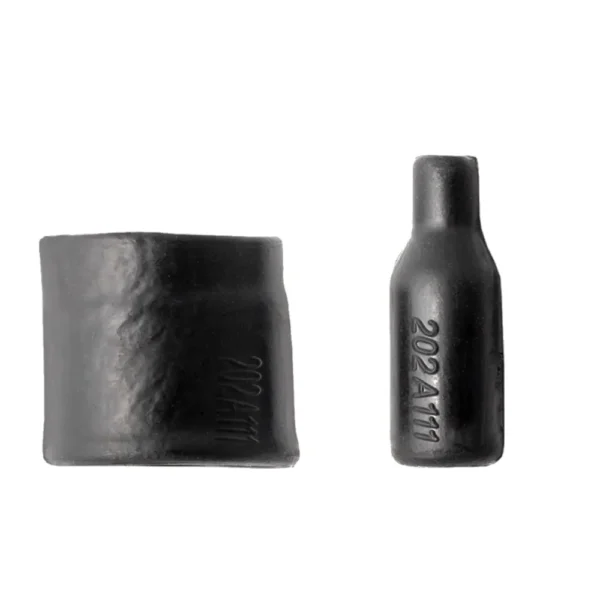
Raychem heat shrink boots and HellermannTyton moulded boots for professional wire harness applications — straight, 90° right-angle, T-shape, and Y-shape transitions in fluid resistant modified elastomer. Also written heatshrink boots (one word) or molded boots (US spelling), and sometimes called connector boots, cable boots, or wire boots, they are used across motorsport, aerospace, and automotive harness builds where environmental sealing, strain relief, and long-term high-temperature performance are required.
What Is a Heat Shrink Boot?
A heat shrink boot is a moulded part made from recoverable elastomer that is placed over a wiring harness transition point — typically at a connector backshell or at a cable split — before recovery with a heat gun. Unlike plain heat shrink tubing, a moulded boot is shaped to match the geometry of the transition: a single cable exit for straight and 90° boots, two or more exits for T-shape and Y-shape transitions.
After recovery the boot forms a tight environmental seal, provides mechanical strain relief, and protects cables against abrasion, vibration, and fluid ingress at the most vulnerable point in the harness.
Key characteristics:
– Material: Fluid Resistant Modified Elastomer — withstands fuel, oil, hydraulic fluid, and cleaning agents
– Operating temperature: -75 °C to +150 °C continuous
– Shrink temperature: minimum +135 °C (use a calibrated heat gun, not open flame)
– Adhesive: not adhesive-lined as standard — requires a two-part harness epoxy for a fully sealed system: HellermannTyton V9500 or its equivalent ResinTech RT125
Boot Shape Guide
Shape
Branches
Typical use
Straight
1 in / 1 out
Connector backshell — harness exits inline with connector axis
Angled branch split from main trunk; more compact than T-shape
Straight boots are the most common choice. Use a 90° (right-angle) boot when the cable must bend sharply immediately behind the connector — a straight boot would cause the cable to strain against the boot wall. T and Y shapes are used at harness branch points rather than at connectors; they are sealed with V9500 epoxy because the multi-branch geometry requires adhesive to fill any gaps at recovery.
Straight vs 90° — Which to Choose
The connector backshell decides this, not preference:
Cable exit direction. Loom runs away in a straight line → straight boot. Chassis or bulkhead forces an immediate turn behind the connector → 90° boot. Forcing a straight boot to bend at the J port strains the boot wall and the insulation under it, and the seal fails first at that flex point.
Chassis clearance. A straight boot needs clear space behind the backshell equal to its P (length) dimension. A 90° boot lets the loom turn within a few millimetres of the connector face, which is the fix for a tight ECU bay or under-dash run.
Strain relief. A 90° boot only relieves strain in the plane it is moulded for. If the loom turns in more than one plane, add a separate clamp near the boot rather than relying on it for multi-axis flex.
XTRA Motorsport sells straight and 90° boots in both Raychem and HellermannTyton.
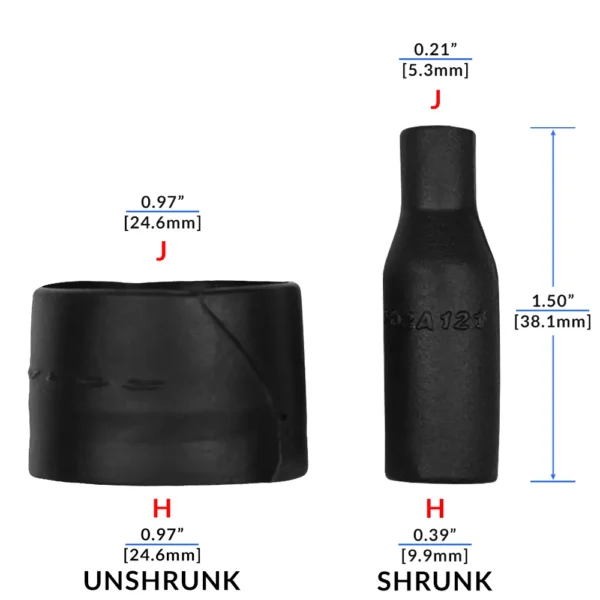
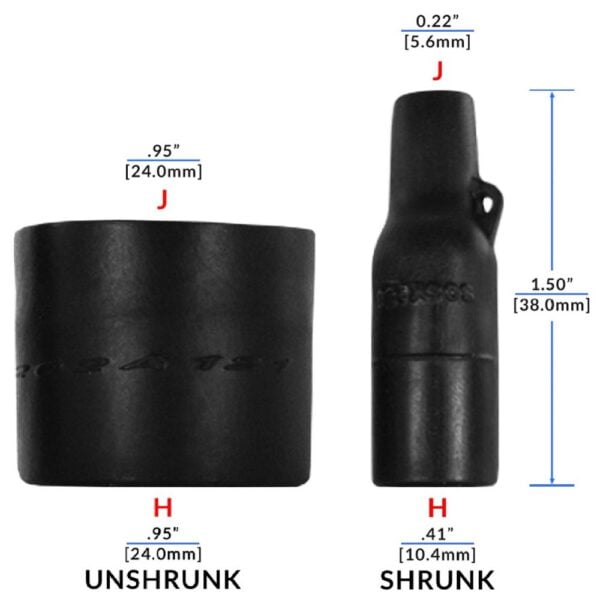
Every Raychem and HellermannTyton boot datasheet lists three core dimensions. XTRA Motorsport lists all dimensions as as-supplied (unshrunk) → after recovery (shrunk).
Dimension
Name
Meaning
H
Big End diameter
The large opening — fits over the connector backshell or harness bundle
J
Small End (port) diameter
The cable exit port — must be matched to the cable outer diameter after recovery
P
Total length
Overall length of the boot after full recovery
R
Entry length
Straight entry length before the boot shoulder (straight boots only)
How to Select the Correct Moulded Boot Size
These are heat shrink moulded boots for wiring harness protection — not footwear. The sizing process is based on connector backshell diameter and cable outer diameter:
Measure the connector backshell outer diameter → this must be ≤ H as-supplied
Measure the cable outer diameter at the exit point → this must be ≥ J after recovery
Confirm P (total length) gives adequate coverage over the strain relief zone
Example: Raychem 202A111-25-G07 — H: 17 → 7.9 mm / J: 17 → 2.2 mm / P: 25 mm. The 2.2 mm recovered J port suits a single 22–24 AWG wire. For a larger cable bundle, choose the 204W series with a larger recovered J.
Lipped vs Non-Lipped Boots
A lipped boot has a moulded retention lip on the large end (H port). The lip locks mechanically against the connector backshell groove or locking ring, preventing the boot from sliding back along the harness under vibration or strain. All Souriau 8STA and Deutsch AS connector boots offered by XTRA Motorsport are lipped.
A non-lipped boot has a plain, open large end. These are used where the connector does not have a backshell groove, or where the harness transitions mid-run rather than at a connector.
Straight lipped — equivalent to Raychem 204W221-25-0
HellermannTyton 1037-4-G
Yes
Straight lipped — ASU shell 03
HellermannTyton 1181-4-G
Yes
90° lipped — equivalent to Raychem 224W221-25-0
HellermannTyton 176-1-G / 177-1-G / 178-1-G
Yes
Straight lipped, large diameter
HellermannTyton 102-1-G / 104-1-G
No
Straight non-lipped, various sizes
Selection by Connector Shell Size — Boot Family
Use this to narrow down which boot family fits before checking the per-connector table below. Shell sizes follow the Deutsch/Souriau numbering cast into the connector backshell.
Shell size range
Typical connectors
Straight boot family
90° boot family
03–06 (micro)
Deutsch ASU shell 03, ASL/8STA/DTM shell 6
Raychem 204W / HellermannTyton 1030-4-G, 1037-4-G
Raychem 224W / HellermannTyton 1181-4-G, 1182-4-G
08–24 (standard)
Deutsch AS, Souriau 8STA larger shells
Raychem 202K
Raychem 222K
Round bodies, no backshell groove
Bosch Kompakt, EV1 injector connectors
Raychem 202A111-25-G07 / HellermannTyton 1030-4-G
not used; these connectors exit straight
Match the boot to the shell size stamped on the backshell first, then confirm fit against the H (big end) and J (small end) dimensions on the specific product page. Shell size gives you the family; the datasheet gives you the exact part number.
Pairing Boots with Raychem DR-25 Tubing
A boot seals one transition point; it does not cover the rest of the loom. Most harnesses built at XTRA Motorsport pair a boot at every connector backshell with Raychem DR-25, a 2:1 general-purpose tube to MIL-DTL-23053/16, running the straight sections between connectors. Both share the same -75 °C to +150 °C range and recovery temperature, so one heat gun pass at 250 °C shrinks boot and tubing together. Size DR-25 to the bundle diameter of the loom trunk; size the boot to the backshell and cable exit as above. A length of DR-25 pulled over a connector will not recover the same way a moulded boot does.
Raychem vs HellermannTyton
Both brands manufacture moulded boots from fluid resistant modified elastomer to the same performance standard. HellermannTyton boots are a direct alternative to Raychem (TE Connectivity) equivalents at lower unit cost. The key differences:
Raychem (TE Connectivity)
HellermannTyton
Part number format
202A, 204W, 224W, 322A series
102-1-G, 1030-4-G, 1209-1-G series
Shapes available
Straight, 90°, T, Y
Straight, 90°, T
Temperature range
-75 to +150 °C
-75 to +150 °C
Adhesive lined
No (standard)
No (standard)
Shrink ratio (H)
~2:1
~2:1
Cross-reference availability
Industry standard
Documented per product page
Raychem part numbers are more widely quoted in connector datasheets and assembly drawings, making them the reference standard. HellermannTyton equivalents are listed on every applicable product page at XTRA Motorsport.
Connector Compatibility
This table shows the recommended boot for each connector type offered by XTRA Motorsport. Straight = inline cable exit; 90° = right-angle exit.
For harness branch points (no connector): use T-shape (Raychem 322A / HellermannTyton 1209-1-G) or Y-shape (Raychem 382A / 462A) with V9500 epoxy.
FAQ
At what temperature do heat shrink boots recover?
Minimum shrink temperature is +135 °C. At XTRA Motorsport we set the heat gun to 250 °C. When recovering a boot on a connector, start at the large end (H port) over the connector backshell and move the air flow evenly toward the small end (J port). This ensures the boot seats correctly against the backshell lip first, then the J port closes tightly around the cable. Do not use open flame — uneven heat causes incomplete recovery and bubbling.
Do I need adhesive with these boots?
Standard Raychem and HellermannTyton moulded boots are not adhesive-lined. For a fully sealed system — particularly in motorsport where the harness is exposed to fuel, oil mist, or water ingress — apply HellermannTyton V9500 Epoxy or ResinTech RT125 inside the boot before fitting. This is mandatory for T-shape and Y-shape transitions. If you need adhesive pre-applied from the factory: Raychem boots with the -225 material code (e.g. 202A111-25-G07 / 202A111-225-0) are adhesive-lined versions; HellermannTyton boots with the -24 suffix have adhesive pre-applied. After recovery, if excess V9500 squeezes out from the J port, wipe it clean before it cures.
What is the difference between Raychem 202A and 204W?
Both are straight lipped boots. The 202A series covers a wider range of sizes including larger H diameters. The 204W series is designed for micro-connector applications — the H diameter is smaller (11 mm as-supplied vs 17 mm for 202A111) and the part is shorter (P = 19 mm vs 25 mm). For Deutsch ASL, ASU, and Souriau 8STA shell size 6, the 204W221-25-0 is the correct fit. The 202A111-25-G07 also fits shell size 6 but with a larger H opening, making it more tolerant of backshell diameter variation.
Can I use HellermannTyton boots instead of Raychem?
Yes — the material specification and shrink ratios are equivalent. Each HellermannTyton product page at XTRA Motorsport lists the Raychem part number it replaces. The cross-reference is verified against dimensional data, not just catalog claims.
What is the J dimension and why does it matter?
J is the small-end port diameter through which the cable exits the boot. After recovery, J shrinks to its recovered value (e.g. 2.2 mm on the 202A111-25-G07). This must be greater than or equal to your cable outer diameter — otherwise the boot will not seal properly around the cable. If your cable is 3.5 mm OD, you need a boot with a recovered J ≥ 3.5 mm. Check the Diameter J attribute on each product page for both the as-supplied and after-recovery values.
What’s the difference between a straight and a 90° heat shrink boot?
A straight boot recovers in a single line: the cable exits the small end (J) on the same axis as the connector. A 90° boot moulds the cable exit at a right angle to the connector axis, so the loom turns immediately behind the backshell instead of needing clear run length to bend. Use straight where the loom continues away from the connector in line; use 90° where chassis clearance forces an immediate turn. Both families come in the same shell-size ranges from Raychem and HellermannTyton (see the shell-size table above).
What are T-shape and Y-shape boots used for?
T-shape and Y-shape boots seal a harness branch point, not a connector: one cable enters and two or more exit. T-shape gives a straight through-run with a perpendicular branch; Y-shape gives a more compact angled split. Neither is used at a connector backshell. Because the multi-branch geometry leaves small gaps at recovery, T and Y boots are always sealed with V9500 or ResinTech RT125 epoxy injected before shrinking, not left dry.
Are these heat shrink boots aerospace or military qualified?
The material (fluid resistant modified elastomer, -75 °C to +150 °C) is the same class used in aerospace and military harness builds, and the Raychem 202/204/222/224 series and HellermannTyton equivalents are common in both motorsport and aerospace harnessing. XTRA Motorsport sells these as commercial motorsport parts. We do not supply certificates of conformance to a specific MIL-DTL or AS spec number, and we don’t stock space-grade or low-outgassing grades some aerospace primes require. Confirm the exact material designation on the datasheet before ordering against a specific mil-spec pull number.
Can heat shrink boots be used with Raychem DR-25 tubing in the same harness?
Yes, and it’s the standard combination on the harnesses we build: DR-25 tubing runs the straight sections of loom, boots seal the connector transitions, and both recover at the same heat gun setting. See the pairing section above for sizing.