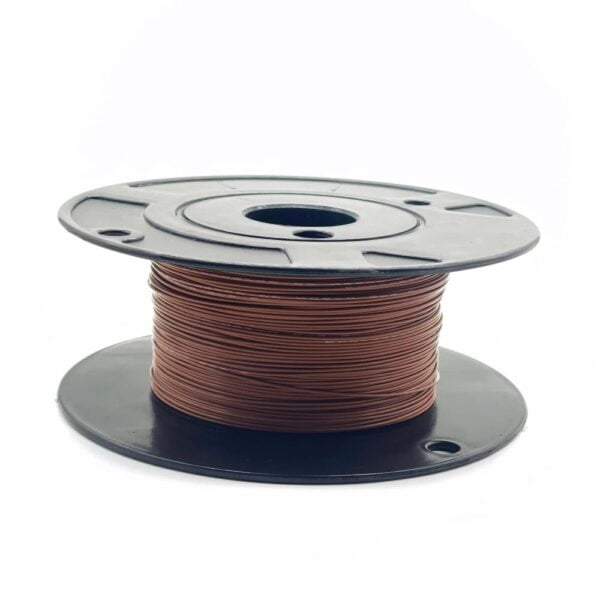
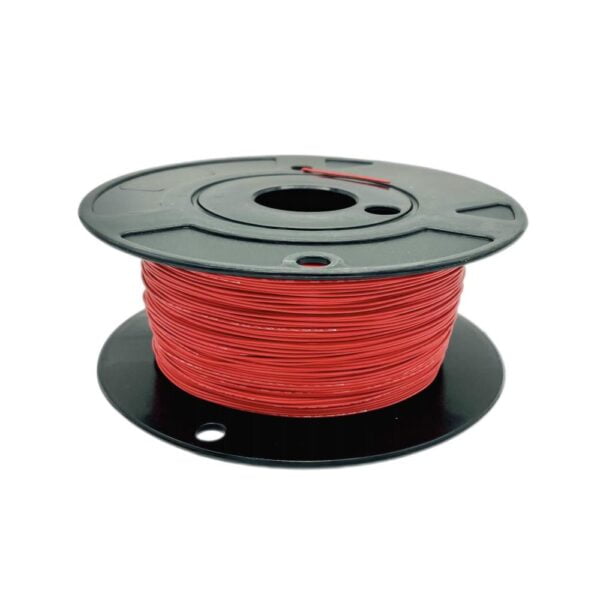
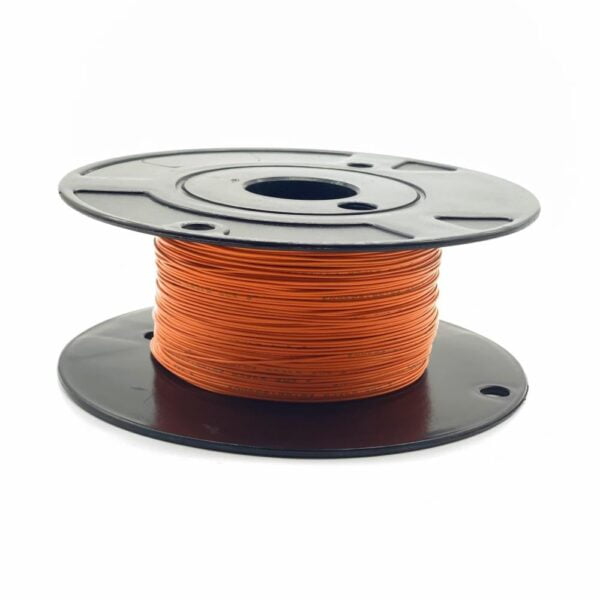
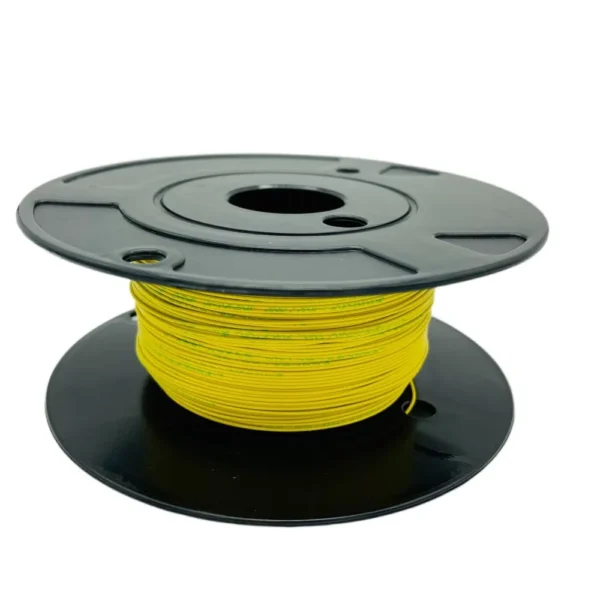
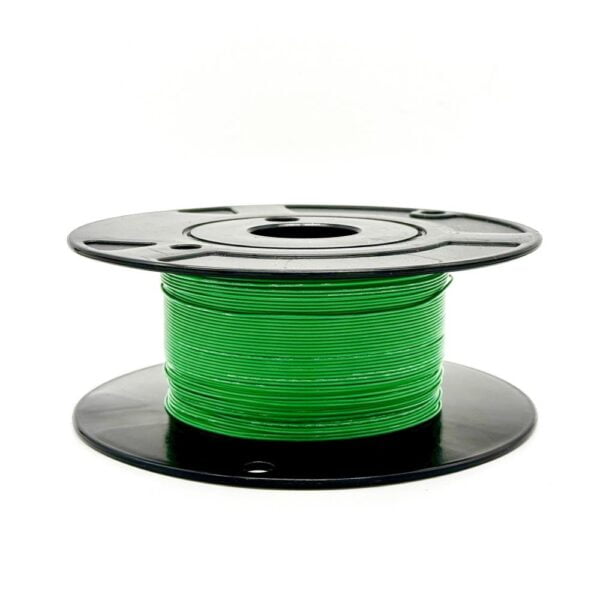
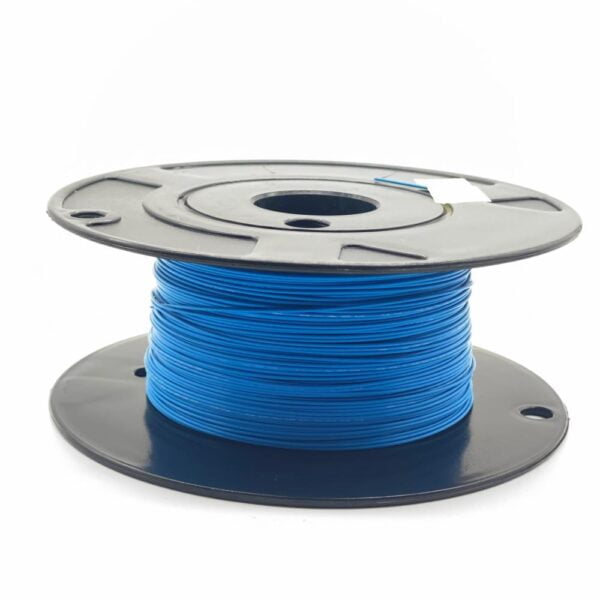
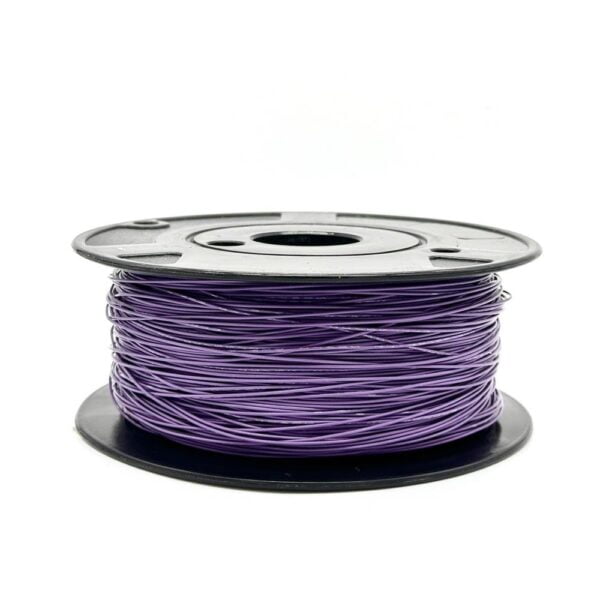
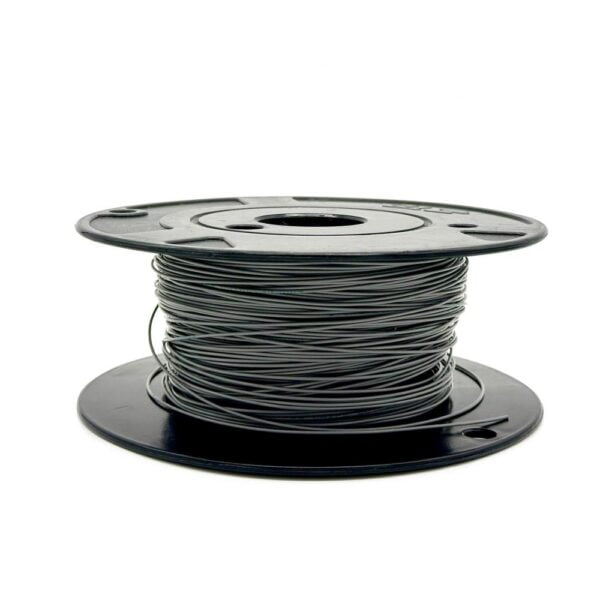
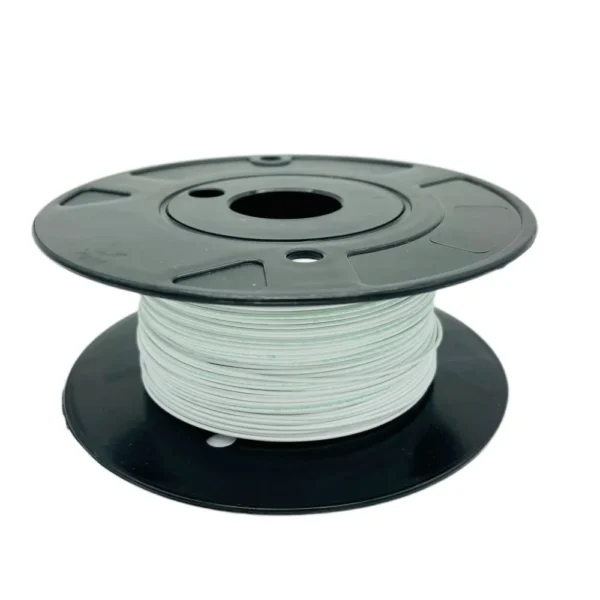
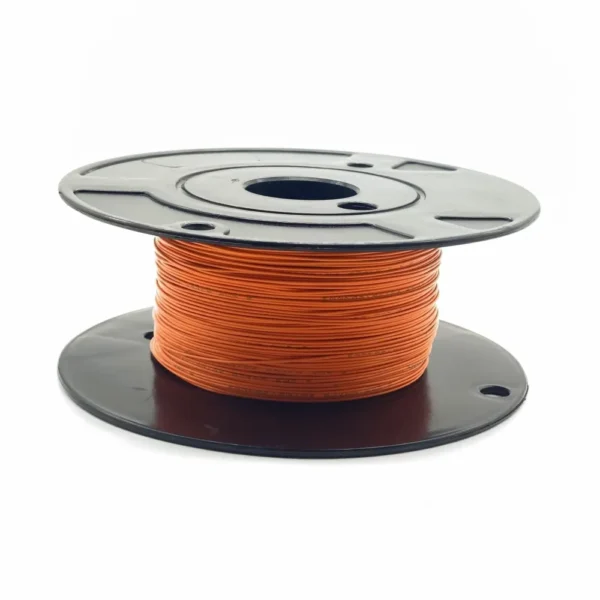
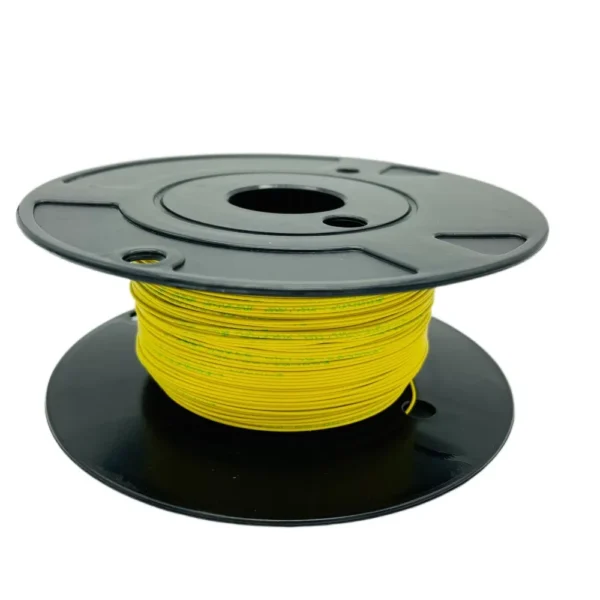
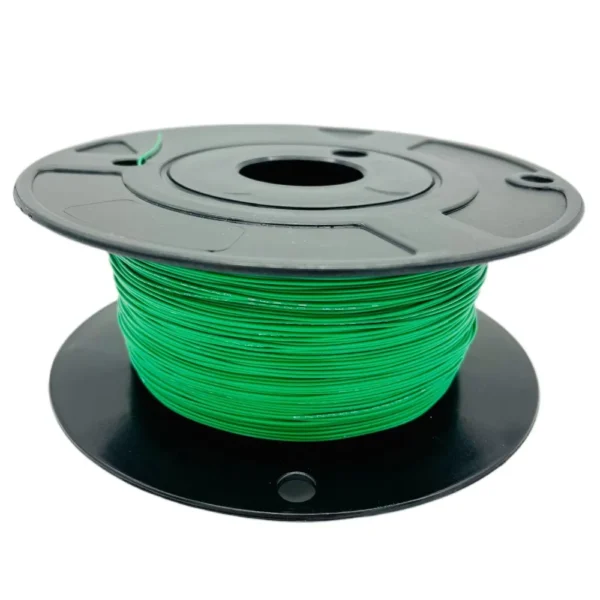
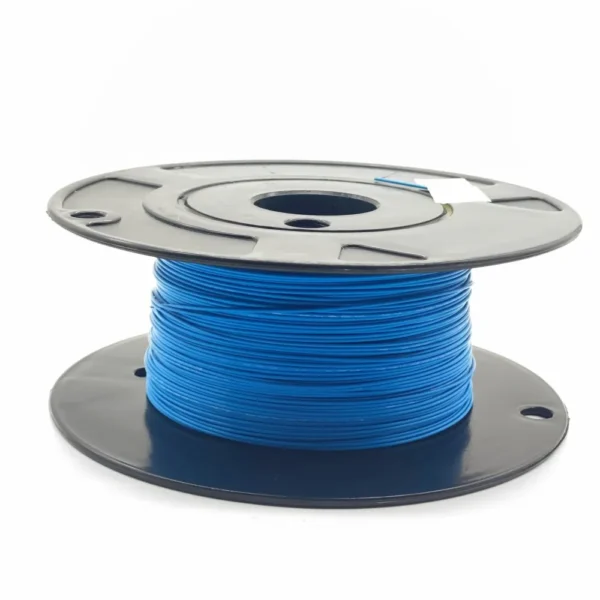
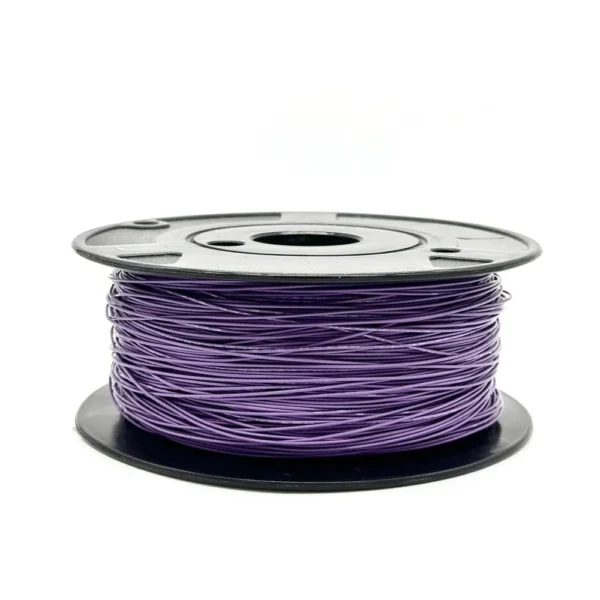
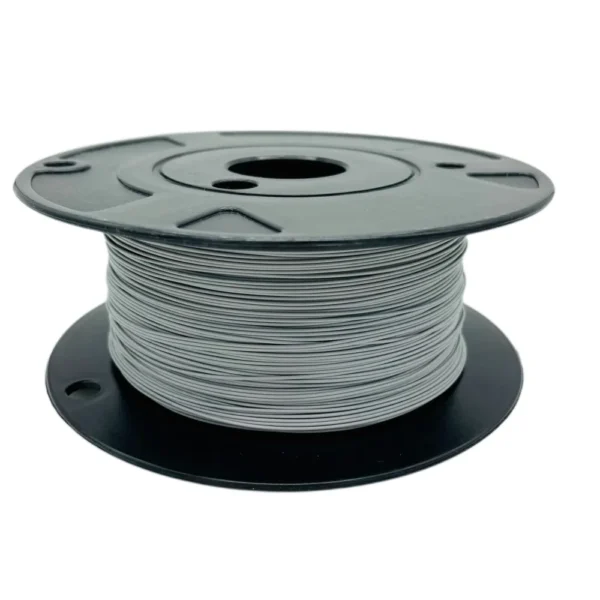
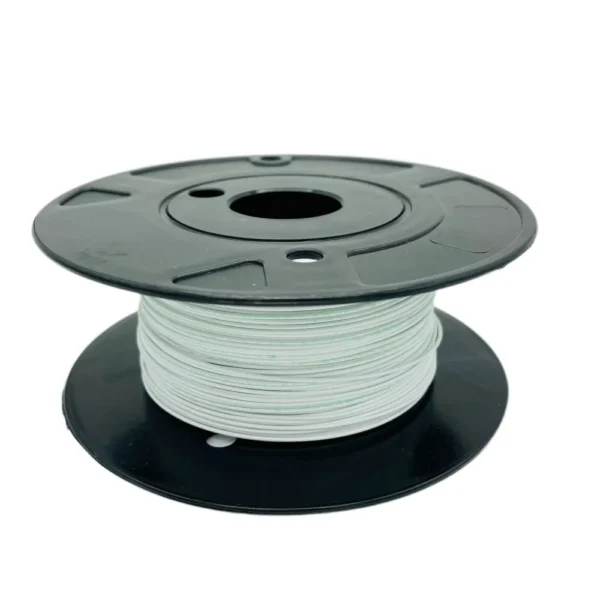
Tefzel wire is the standard choice for professional motorsport wiring harnesses. The insulation material is ETFE (ethylene tetrafluoroethylene) — a fluoropolymer related to PTFE, but lighter and with better mechanical toughness. In motorsport and mil-spec applications, cross-linked modified ETFE is used: radiation cross-linking tightens the polymer structure, improving abrasion resistance and cut-through performance without adding weight.
The primary mil-spec designation is MIL-DTL-22759/32 (SAE AS22759/32). Raychem (now TE Connectivity) manufactures the same wire under the brand name Spec55, part series 55A0111. Both names refer to the same specification: tin-plated annealed copper conductor, cross-linked modified ETFE insulation, rated to 150°C and 600 V.
Note: “Spec55” is a TE Connectivity product family that covers multiple SAE AS22759 sub-specifications. XTRA Motorsport stocks M22759/32 — the thin-wall, tin-plated, 150°C variant. For the silver-plated 200°C variant (also sometimes called Spec55 by builders), see the sub-specification section below.
Per SAE-AS22759/32 (OD values are min–max per specification). Working current is the recommended safe continuous load for a single conductor in free air with a 30°C temperature rise above ambient — derived from the Marmon Aerospace & Defense ampacity table. Bundle derating: ×0.72 for 3 conductors, ×0.53 for 7 conductors. DC resistance values per MIL-DTL-22759/32 (maximum, at 20°C).
AWG
Stranding
OD min–max (mm)
Conductor (mm²)
Weight (g/m)
DC resistance (Ω/1000ft)
Working current
12
37/28
2.54–2.69
3.31
29.3
2.02
27 A
14
19/27
2.08–2.24
2.08
19.3
3.06
21 A
16
19/29
1.68–1.78
1.31
12.4
4.81
15 A
18
19/30
1.47–1.57
0.82
9.7
6.23
13 A
20
19/32
1.22–1.32
0.52
6.4
9.88
10 A
22
19/34
1.04–1.14
0.33
4.2
16.2
8 A
24
19/36
0.89–0.99
0.21
3.0
26.2
6 A
26
19/38
0.76–0.86
0.13
2.1
41.3
4 A
Part number suffix: M22759/32-{AWG}-{colour} and Spec55 55A0111-{AWG}-{colour}, where colour follows MIL-STD-681: 0=Black, 1=Brown, 2=Red, 3=Orange, 4=Yellow, 5=Green, 6=Blue, 7=Violet, 8=Grey, 9=White. Two-digit suffix (e.g. -09) = white with black stripe.
AWG Selection by Circuit Type
CAN bus (CAN High / CAN Low): use Spec55 twisted CAN wire (55A0121) — twisted pair construction is required for CAN, not single-core
Main power distribution, high-current feeds: 12 AWG
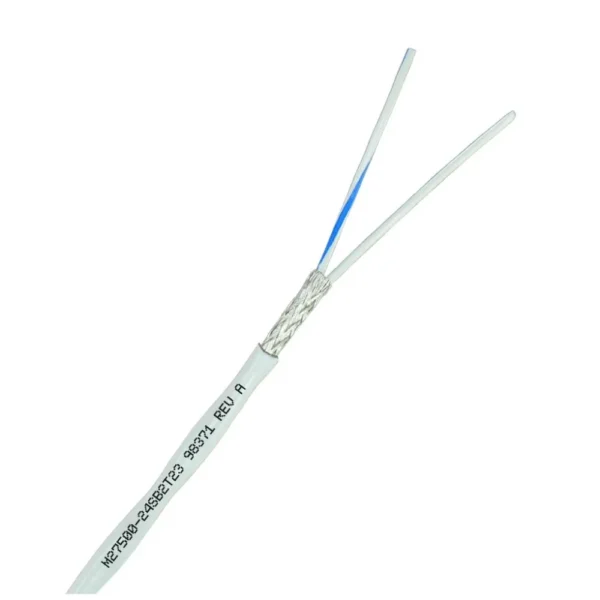
Shielded trigger and knock sensor wiring: use M27500 shielded wire — M27500 uses M22759/32 conductors with an aluminium foil shield
M22759 Sub-Specifications
The SAE AS22759 family contains multiple sub-specifications. The difference that matters most for motorsport is conductor plating and temperature rating:
Spec
Conductor plating
Insulation wall
Temp rating
Typical OD at 22 AWG
XTRA stock
Primary use
M22759/16
Tin
0.013 in (thick)
150°C
~1.35 mm
No
OEM seal compatibility, abrasion-prone zones, street builds requiring standard seal bore fit
M22759/32
Tin
0.005 in (thin)
150°C
1.04–1.14 mm
Yes
Professional motorsport harnesses — Autosport, Souriau, Deutsch connectors
M22759/33
Silver
0.006 in
200°C
similar to /32
No
200°C zones, enhanced flex life
M22759/44
Silver
0.005 in
200°C
similar to /32
No
Near-exhaust routing, weight-critical 200°C builds — often called “Spec55 200°C”
Practical note: When motorsport engineers say “Spec55,” they may mean M22759/32 (the Raychem product name for the 150°C tin-plated variant) or M22759/44 (the 200°C silver-plated variant). For most ECU harness work, M22759/32 at 150°C is sufficient. Route away from exhaust and turbo outlet heat sources; for circuits that must pass through high-heat zones, specify M22759/44.
M22759/16 vs /32 — the OEM seal question: M22759/16 at 22 AWG (~1.35 mm OD) is close to typical OEM rubber wire seal bore sizes, making it a drop-in fit for factory connectors. M22759/32 at 22 AWG (1.04–1.14 mm) is thinner — it may need a short sleeve of Raychem SCL heat shrink to build up OD at an OEM seal. In motorsport connectors (Autosport, ASL, Souriau 8STA, Deutsch DT/AS), /32 fits correctly without modification.
M22759/32 vs TXL Wire
TXL (SAE J1128) is the standard wire for OEM automotive wiring harnesses. The comparison below is for 22 AWG, the most common gauge in motorsport ECU harnesses.
For a 200-circuit harness with an average 1.5 m per circuit, substituting M22759/32 for TXL at 22 AWG saves approximately 500 g — meaningful for a club or professional racing build.
Per metre: Ordering by the metre gives one continuous cut length — not separate pieces. 5 m ordered = one 5 m length, hand-wound loose.
Full spools: Factory spools are supplied wound. Contact us for spool pricing on high-volume requirements.
Worldwide Shipping
XTRA Motorsport ships M22759/32 Tefzel wire globally via DHL Express and UPS. Wire is cut to order from EU stock and dispatched within 1–2 business days of order confirmation.
Region
Carrier
Transit
Europe (EU, UK, CH, NO)
DHL Express / UPS
1–3 business days
United States & Canada
DHL Express
3–5 business days
Australia & New Zealand
DHL Express
4–6 business days
Japan & Asia Pacific
DHL Express
3–5 business days
Rest of world
DHL Express
4–7 business days
M22759/32 Tefzel wire is used by wiring harness builders across the US (IMSA, NASA, SCCA, time attack), Australia (Supercars, WTAC), and internationally for GT3/GT4 OEM programmes. All wire ships with a batch certificate of conformance to SAE AS22759/32 on request.
FAQ
What is the difference between M22759/32 and Spec55?
M22759/32 is the mil-spec designation (SAE AS22759/32). Spec55 is the Raychem/TE Connectivity brand name for wire manufactured to the same specification. The part number series 55A0111 (Spec55) and M22759/32 are functionally identical for motorsport use. However, “Spec55” is also used informally to refer to M22759/44 — the 200°C silver-plated variant. XTRA Motorsport stocks M22759/32 (tin-plated, 150°C). If you need the 200°C silver variant, specify M22759/44 or M22759/33.
What is the difference between M22759/32 and M22759/44 — which should I use?
M22759/32 uses tin-plated copper and is rated to 150°C. M22759/44 uses silver-plated high-strength copper and is rated to 200°C. Both use the same thin 0.005 in ETFE wall, so OD and weight are nearly identical. For the vast majority of ECU harness circuits — sensors, injectors, I/O, power distribution — M22759/32 at 150°C is sufficient, provided the harness is routed away from direct exhaust heat. Use M22759/44 only for circuits that must route through sustained high-temperature zones (exhaust tunnel, turbo outlet area).
Is Tefzel wire the same as PTFE wire?
No. Tefzel is the DuPont brand name for ETFE (ethylene tetrafluoroethylene), which is a different polymer to PTFE (polytetrafluoroethylene, also called Teflon). For motorsport, cross-linked modified ETFE (M22759/32) is preferred over PTFE because it has higher tensile strength (38–48 MPa vs 13–25 MPa for PTFE), better abrasion resistance, and is significantly lighter.
What temperature can M22759/32 wire handle?
Continuous rated temperature is 150°C (−65°C to +150°C). The insulation passes an ageing test at 300°C for 7 hours without failure — this is a production verification test, not a continuous operating limit. For circuits requiring 200°C continuous rating, use M22759/44 (silver-plated conductor, identical wall profile).
Can I use M22759/32 with factory OEM rubber wire seals?
The thin ETFE wall gives M22759/32 a smaller OD than most OEM wire seal bores — at 22 AWG, OD is 1.04–1.14 mm vs a typical OEM seal bore of ~1.3–1.5 mm. A short sleeve of Raychem SCL heat shrink over the seal zone builds OD to fit. For dedicated motorsport connectors (Autosport, ASL, ASU, Souriau 8STA, Deutsch DT/AS/DTP), M22759/32 is the correct wire and fits without modification. If OEM seal compatibility is a priority throughout, consider M22759/16 instead, which has a thicker wall and larger OD closer to OEM seal sizing.
Can I use standard automotive wire strippers on Tefzel wire?
Standard blade strippers are not recommended. The thin ETFE wall (0.005 in) and 19-strand construction require precision strippers with a blade gap matched to the wire gauge. Incorrect stripping nicks the tin-plated strands and reduces pull-out strength at crimp terminations. The correct tool is the Ideal Ergo-Elite Stripmaster (part 55-1987) for 16–26 AWG M22759 wire.
How much weight does M22759/32 save compared to TXL wire?
At 22 AWG, M22759/32 weighs 4.2 g/m versus TXL at approximately 5.95 g/m — approximately 29% lighter. For a 200-circuit harness with an average 1.5 m per circuit, the weight saving over TXL is approximately 500 g. At 20 AWG the saving is approximately 17%. The combination of thinner OD and lower weight makes M22759/32 the standard choice for any build where harness mass is a design parameter.
0.90 €–74.00 €Price range: 0.90 € through 74.00 € excl. VATSelect options
This product has multiple variants. The options may be chosen on the product page
0.90 €–70.00 €Price range: 0.90 € through 70.00 € excl. VATSelect options
This product has multiple variants. The options may be chosen on the product page
0.90 €–189.00 €Price range: 0.90 € through 189.00 € excl. VATSelect options
This product has multiple variants. The options may be chosen on the product page
0.90 €–72.00 €Price range: 0.90 € through 72.00 € excl. VATSelect options
This product has multiple variants. The options may be chosen on the product page
0.90 €–78.00 €Price range: 0.90 € through 78.00 € excl. VATSelect options
This product has multiple variants. The options may be chosen on the product page
0.90 €–72.00 €Price range: 0.90 € through 72.00 € excl. VATSelect options
This product has multiple variants. The options may be chosen on the product page
0.90 €–74.00 €Price range: 0.90 € through 74.00 € excl. VATSelect options
This product has multiple variants. The options may be chosen on the product page
0.90 €–189.00 €Price range: 0.90 € through 189.00 € excl. VATSelect options
This product has multiple variants. The options may be chosen on the product page
0.90 €–70.00 €Price range: 0.90 € through 70.00 € excl. VATSelect options
This product has multiple variants. The options may be chosen on the product page
0.75 €–62.00 €Price range: 0.75 € through 62.00 € excl. VATSelect options
This product has multiple variants. The options may be chosen on the product page
0.75 €–62.00 €Price range: 0.75 € through 62.00 € excl. VATSelect options
This product has multiple variants. The options may be chosen on the product page
0.75 €–62.00 €Price range: 0.75 € through 62.00 € excl. VATSelect options
This product has multiple variants. The options may be chosen on the product page
0.75 €–62.00 €Price range: 0.75 € through 62.00 € excl. VATSelect options
This product has multiple variants. The options may be chosen on the product page
0.75 €–62.00 €Price range: 0.75 € through 62.00 € excl. VATSelect options
This product has multiple variants. The options may be chosen on the product page
0.75 €–159.90 €Price range: 0.75 € through 159.90 € excl. VATSelect options
This product has multiple variants. The options may be chosen on the product page
0.75 €–62.00 €Price range: 0.75 € through 62.00 € excl. VATSelect options
This product has multiple variants. The options may be chosen on the product page
0.75 €–62.00 €Price range: 0.75 € through 62.00 € excl. VATSelect options
This product has multiple variants. The options may be chosen on the product page
0.75 €–62.00 €Price range: 0.75 € through 62.00 € excl. VATSelect options
This product has multiple variants. The options may be chosen on the product page
0.75 €–59.00 €Price range: 0.75 € through 59.00 € excl. VATSelect options
This product has multiple variants. The options may be chosen on the product page
3.85 €–371.90 €Price range: 3.85 € through 371.90 € excl. VATSelect options
This product has multiple variants. The options may be chosen on the product page