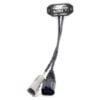


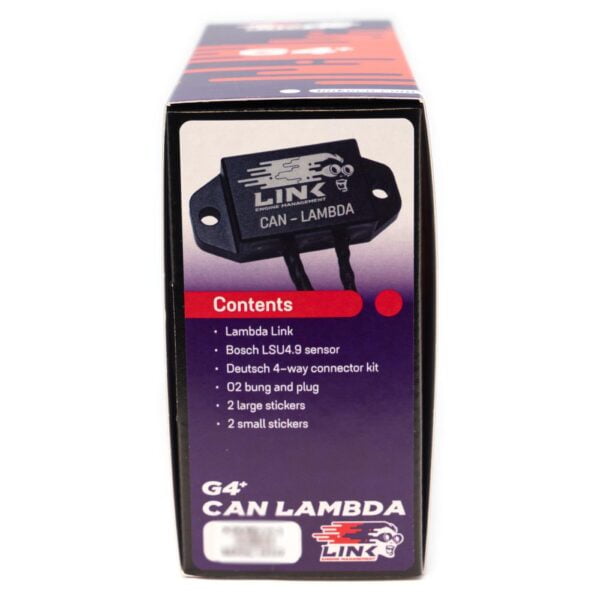

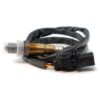
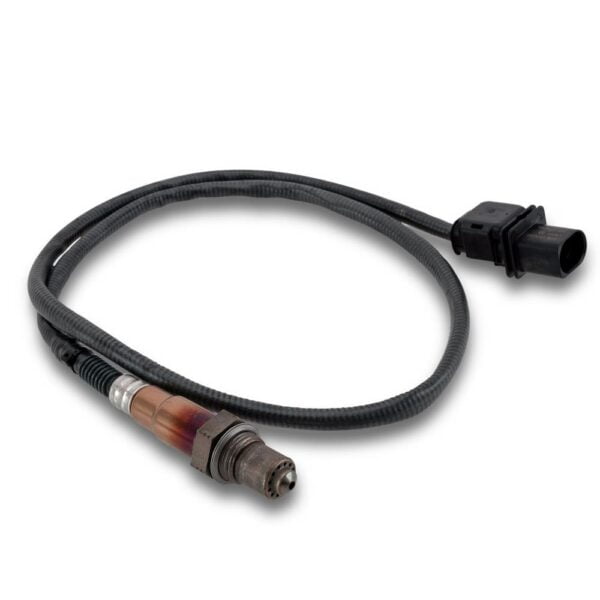
The Link CAN Lambda is a digital wideband lambda controller that transmits air/fuel ratio data via CAN bus. It includes a Bosch LSU 4.9 sensor and requires no free-air calibration — the Rcal resistor factory-trimmed into each LSU 4.9 sensor provides the calibration reference automatically at power-on. The module has no 0–5 V analogue output; it is designed as a CAN-only device, eliminating the signal degradation and noise susceptibility of analogue wideband systems.
The module connects to the ECU or CAN bus via a 4-pin Deutsch DTM connector (power, ground, CAN H, CAN L). The LSU 4.9 sensor plugs directly into the 6-pin Bosch connector on the module’s 170 mm lead — no separate sensor wiring is required. A second unit can be added to the same CAN bus at CAN ID 951 for dual-sensor builds, or where the ECU (e.g. G5 Voodoo Pro) already has an onboard wideband and a second channel is needed.
Technical Specifications
| Property | Value |
|---|---|
| SKU | 125-1000 |
| Sensor | Bosch LSU 4.9 (included) |
| Sensing range | 0.67–10 lambda |
| Output type | CAN bus only — no analogue (0–5 V) output |
| CAN default baud rate | 1 Mbit/s |
| Supported baud rates | 1 Mbit/s, 500 kbit/s, 250 kbit/s, 125 kbit/s |
| Default CAN ID | 950 (second unit: 951) |
| Power connector | 4-pin Deutsch DTM (male) |
| Sensor connector | 6-pin Bosch LSU 4.9 (on module lead) |
| Controller supply voltage | 7.5–20 V |
| Sensor heater supply voltage | 10.8–16.5 V |
| Controller current draw | 100 mA |
| Sensor heater current | Up to 8 A (warm-up); lower in steady state |
| Operating temperature | −20°C to +100°C |
| Dimensions | 60 × 26 × 15 mm |
| Lead length | 170 mm |
| Weight | 70 g |
| Calibration | None required — Rcal resistor on sensor, read at power-on |
Connector Pinout
4-Pin Deutsch DTM — Power and CAN
Mating connector: Deutsch DTM 4-way socket (supplied in kit).
| Pin | Signal | Wire size (min) | Notes |
|---|---|---|---|
| 1 | Power + | 0.85–1.00 mm² | 10 A fused supply via relay |
| 2 | GND | 0.85–1.00 mm² | Chassis ground |
| 3 | CAN L | 0.3–0.35 mm² | Twisted pair with CAN H |
| 4 | CAN H | 0.3–0.35 mm² | Twisted pair with CAN L |
6-Pin Bosch LSU 4.9 Sensor Connector — On Module Lead
The Bosch LSU 4.9 sensor plugs directly into this connector. No separate wiring between sensor and module.
| Pin | Signal | Description |
|---|---|---|
| 1 | APE | Analogue pump electrode |
| 2 | IPE | Ion pump electrode (current) |
| 3 | Heater − | Heater negative |
| 4 | Heater + | Heater positive (from module power supply) |
| 5 | MES | Nernst cell measurement electrode |
| 6 | RE / Rcal | Reference electrode + calibration resistor |
Lambda and AFR Reference
The module transmits lambda as a floating-point CAN value. AFR conversion is stoichiometry-dependent and is applied by the ECU or dash. Stoichiometric AFR for common fuels:
| Fuel | Stoichiometric AFR |
|---|---|
| Petrol (gasoline) | 14.7:1 |
| E85 ethanol blend | 9.8:1 |
| Ethanol (E100) | 9.0:1 |
| Methanol | 6.5:1 |
Lambda to AFR conversion for petrol (multiply lambda × 14.7):
| Lambda | AFR (petrol) | Mixture condition |
|---|---|---|
| 0.70 | 10.3:1 | Very rich |
| 0.80 | 11.8:1 | Rich |
| 0.90 | 13.2:1 | Mild rich |
| 1.00 | 14.7:1 | Stoichiometric |
| 1.10 | 16.2:1 | Mild lean |
| 1.20 | 17.6:1 | Lean |
| 1.30 | 19.1:1 | Very lean |
Wiring Notes
Standard wiring: Battery → ignition switch → 10 A fuse → relay → pin 1 (Power+). Pin 2 (GND) to chassis ground. CAN H and CAN L as twisted pair to ECU CAN bus.
Voltage spike protection (recommended): Add a 22 μF / 35 V electrolytic capacitor across the supply on the module side of the relay. The LSU 4.9 heater switches significant current during warm-up; the capacitor absorbs voltage transients that can otherwise corrupt CAN frames.
CAN bus termination: A 120 Ω termination resistor must be present at each end of the CAN bus. The CAN Lambda does not include an internal terminator.
ECU Compatibility
| ECU / System | Compatibility | Notes |
|---|---|---|
| Link G4+, G4X, G5 | Native — select “Link CAN Lambda” in PCLink | Default CAN ID 950; second unit uses ID 951 |
| MoTeC M1 series | Confirmed | Supported in M1 Tune via CAN template |
| Emtron KV / SL series | Custom CAN configuration | Emtron supports its own ELC module natively; CAN Lambda can work via custom CAN stream setup |
| Haltech, Syvecs, AiM | Custom CAN configuration | Any ECU or dash with configurable CAN input and user-defined ID, baud rate, and byte offset |
| Link G4 (early) | Not compatible | No CAN input on G4 generation — use analogue wideband |
Plug-in ECU cable note: Link G4+/G4X plug-in ECUs access the CAN port differently depending on version:
– Older 5-pin CAN port: requires CANPCB cable + CANF field-insertable CAN plug (sold separately)
– Newer 4-pin powered CAN port: requires CANJST4 cable (sold separately; max 3 A continuous for all devices on that port)
In the Box
- CAN Lambda module with 170 mm lead
- Bosch LSU 4.9 wideband sensor
- Deutsch DTM 4-way connector kit
- M18×1.5 O2 bung and plug
- Quick start guide
Frequently Asked Questions
Does the Link CAN Lambda have a 0–5 V analogue output?
No. The module is CAN bus only by design. There is no analogue voltage output. This eliminates the noise floor, ground offset errors, and cable length limitations of analogue wideband systems. The ECU or dash must have a configurable CAN input to use this module.
Do I need to perform free-air calibration before use?
No. The Bosch LSU 4.9 sensor contains a laser-trimmed Rcal resistor (pin 6) unique to each sensor. The module reads this at power-on and calibrates automatically. No free-air calibration procedure is required at installation or after sensor replacement — fit a new LSU 4.9 and the module recalibrates on start-up.
What CAN ID and baud rate does the module use, and can I change them?
Default CAN ID is 950 at 1 Mbit/s. Both are user-changeable via PDM Link software or the inline configuration procedure described in the instruction manual. Supported baud rates: 1 Mbit/s, 500 kbit/s, 250 kbit/s, 125 kbit/s. For two units on the same bus, set the second unit to CAN ID 951.
Will the CAN Lambda work with an Emtron KV or Haltech ECU?
With custom CAN configuration, yes. Configure a custom CAN receive channel on the ECU matching CAN ID 950, 1 Mbit/s baud rate, with byte offset and scaling from the Link CAN Lambda instruction manual. Emtron’s own ELC module is natively supported by Emtron ECUs; the CAN Lambda is a functional alternative but requires manual CAN setup.


Reviews
There are no reviews yet.