

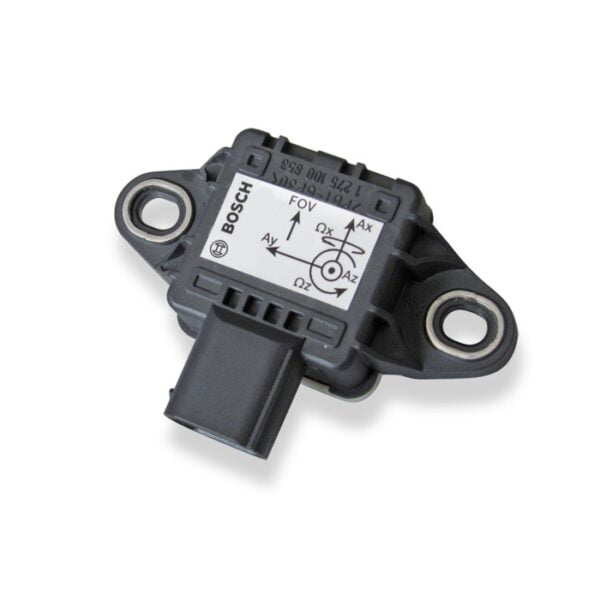
The Bosch Motorsport MM5.10 is a compact 5-degree-of-freedom inertial measurement unit, measuring longitudinal, lateral, and vertical linear acceleration plus yaw rate and roll rate in a single CAN-connected device. It uses the same MEMS sensing architecture as the MM7.10 — Coriolis-effect rotational sensors combined with surface micro-machined linear accelerometers — in a package that is 7 g lighter and 2.3 mm shallower. The missing axis is pitch rate; for applications that require pitch rate measurement, the MM7.10 is the appropriate choice.
All six measured values (three linear + two rotational + temperature reference) are broadcast simultaneously on the 1 Mbaud CAN bus at 1 Mbaud rate. CAN IDs 0x0170 (Rx) and 0x75 (Rx) are reserved for sensor synchronisation and configuration — verify these are free on your network before installation.
The MM5.10 is available in four variants to match different harness integration approaches. The bare sensor (without wire) requires the team to build their own harness connector. The open-end wire variant provides a sensor with a pigtail ending in bare wire for splicing into an existing harness. The motorsport connector variant provides a harness-ready termination for direct connection to a Bosch Motorsport-compatible harness plug. The ABS M5 variant is configured specifically for direct integration with the Bosch Motorsport ABS M5 system — if you are installing the MM5.10 alongside an ABS M5 Clubsport, this is the correct variant.
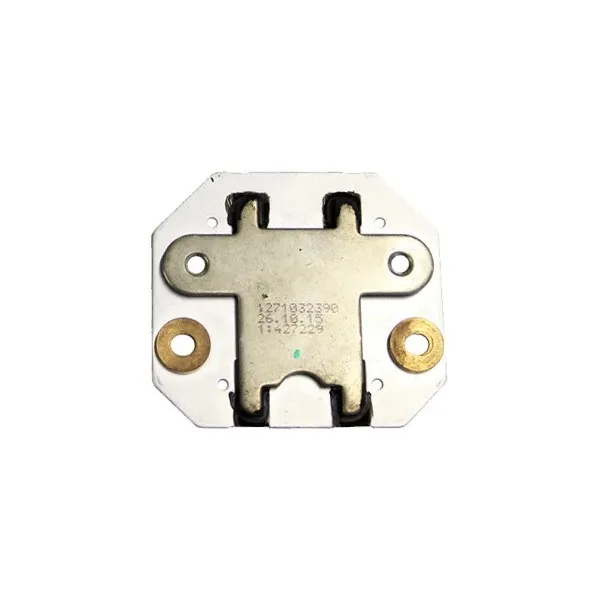
A dedicated damping plate is available for installations where chassis vibration may exceed the sensor’s structural tolerance or affect measurement quality.
Technical Specifications
| Property | Value |
|---|---|
| Measurement axes | 3 linear (X, Y, Z) + 2 rotational (yaw, roll) = 5 DOF |
| Linear range | ±4.2 g |
| Rotational range | ±163 °/s |
| Output | 1 Mbaud CAN |
| CAN sync ID | 0x0170 (Rx) or 0x75 (Rx) |
| Supply voltage | 7 – 18 V |
| Dimensions | 80 × 56 × 21 mm |
| Weight | 28 g (without wire) |
| IP rating | IP6K7 |
Variants — Which One to Order
| Variant | When to use |
|---|---|
| Without wire | You are building a custom harness with your own connector and wire |
| Wire with open end | You want a pigtail for splicing into an existing harness loom |
| Wire with Motorsport connector | You want a harness-ready unit with a pre-fitted motorsport connector |
| Without wire, for ABS M5 1Mbaud | Use this variant when installing alongside a Bosch Motorsport ABS M5 system |
What You Can Do With It
- Measure the lateral, longitudinal, and vertical acceleration of the vehicle simultaneously
- Monitor yaw rate for live oversteer/understeer detection and closed-loop stability control inputs
- Measure roll rate for active suspension and damper control algorithms
- Feed all 5 channels to the Bosch Motorsport VCU, ECU, or data logger via standard 1 Mbaud CAN
- Integrate directly with the Bosch Motorsport ABS M5 system using the dedicated ABS M5 variant
- Mount with a damping plate to reduce vibration contamination in high-frequency environments
- Log all channels in WinDarab V7 via the Bosch Motorsport C70, C80, or any CAN-capable logger
MM Sensor Comparison
| Model | DOF | Rotation Axes | Dimensions | Weight |
|---|---|---|---|---|
| MM5.10 | 5 (3 linear + 2 rotational) | Yaw, Roll | 80 × 56 × 21 mm | 28 g |
| MM7.10 | 6 (3 linear + 3 rotational) | Yaw, Pitch, Roll | 80 × 56 × 23.3 mm | 35 g |
Accessories
- MM7.10 IMU — 6-axis version with pitch rate measurement
- Damping Plate for MM5.10 — vibration isolation mount for the MM5.10
- ABS M5 Clubsport — ABS system that uses the MM5.10 ABS M5 variant directly
- MSA-Box II — required for configuration
- C70 Data Logger — standalone logger for MM5.10 CAN data
FAQ
What is the difference between the MM5.10 and MM7.10?
The MM7.10 adds pitch rate measurement — the third rotational axis. The MM5.10 measures yaw rate and roll rate only. If your application requires pitch rate (hillclimb, rally, longitudinal load transfer analysis, or full 6-DOF chassis dynamics), use the MM7.10. If yaw, roll, and linear acceleration are sufficient — which covers most circuit traction and stability control applications — the MM5.10 is the more compact and lighter option.
Which MM5.10 variant should I order?
If you are installing alongside a Bosch Motorsport ABS M5 system, order the “Without wire, for ABS M5 1Mbaud” variant — it has a pre-configured CAN ID matching the ABS M5’s expected input. For all other applications, choose the variant that matches your harness construction: without wire if building custom, open end for splicing, or motorsport connector for a plug-in harness.
Does the MM5.10 need the damping plate?
The damping plate is recommended for installations where the mounting point experiences high-amplitude chassis vibration — for example, mounting directly on a subframe or suspension component rather than a bulkhead or monocoque. The plate attenuates structural vibration that would otherwise appear as noise in the sensor output. For typical cabin-floor or tunnel mounting, the damping plate is optional.
How does the MM5.10 connect to the ABS M5 system?
The “Without wire, for ABS M5 1Mbaud” variant is configured with CAN IDs and output message format specifically matched to the Bosch Motorsport ABS M5 system’s input requirements. It connects to the ABS M5 CAN bus and is recognised automatically — no manual CAN configuration is required. All other MM5.10 variants use the standard MM5.10 CAN message format and are not directly compatible with the ABS M5 without reconfiguration.
What mounting orientation is required for the MM5.10?
The MM5.10 should be mounted with the connector facing rearward (opposite to the direction of travel). The sensor axes are defined relative to its own coordinate frame — yaw, roll, and the three linear axes correspond to vehicle axes only when mounted correctly. Mounting angle corrections (offset, rotation) can be applied in software if the sensor is not perfectly aligned to the vehicle axes.



Reviews
There are no reviews yet.