
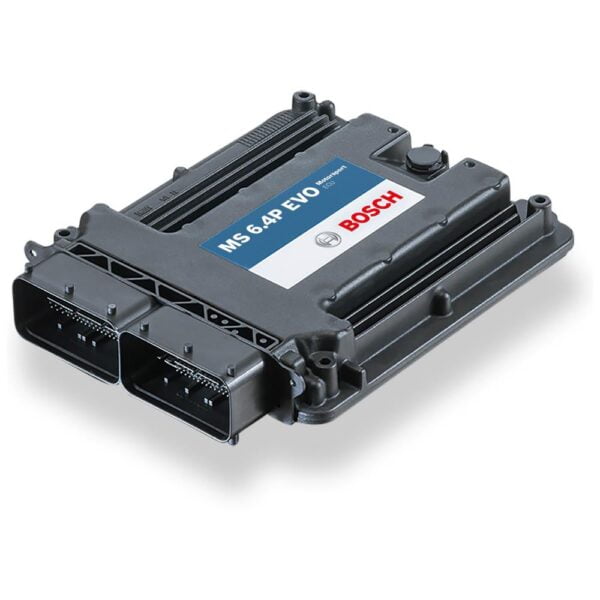
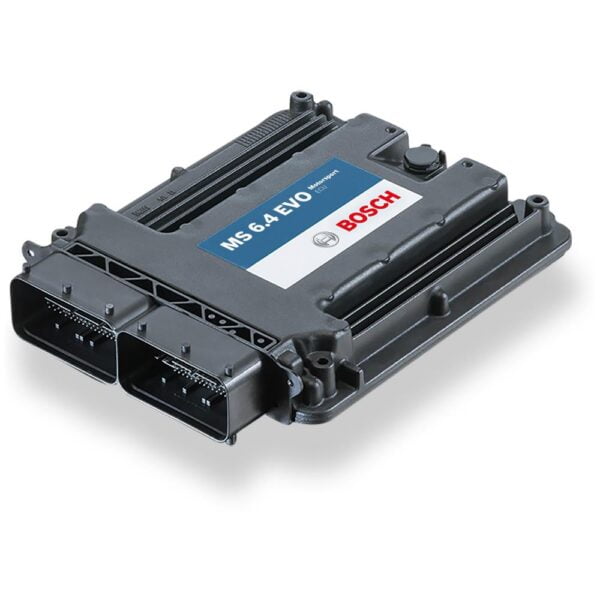
The Bosch Motorsport MS 6.4P EVO shares the same chassis, connector interface, and overall hardware architecture as the MS 6.4 EVO — but internally it uses an 866 MHz dual-core CPU rather than the 667 MHz processor found in every other MS 6 EVO variant. The additional CPU performance is intended for engineering teams running computationally intensive Customer Code Area (CCA) algorithms in MATLAB/Simulink: model-predictive combustion control, advanced traction and stability functions, or real-time hybrid system integration where the CCA loop must execute reliably within tight cycle times.
The memory upgrade path also differs: the MS 6.4P EVO supports an optional 16 GB logging expansion, compared to 4 GB on all other MS 6 EVO variants. This is significant for long-distance endurance sessions where continuous high-rate logging across 1,500 channels would fill a 4 GB partition in under an hour.
Critical note for calibrators: The MS 6.4P EVO requires a specific, dedicated software version in RaceCon. It is not compatible with the software used on the MS 6.4 EVO or any other MS 6 EVO variant. RaceCon project files from MS 6.4 installations cannot be loaded directly onto the 6.4P — migration to the dedicated software branch is required before use.
The MS 6.4P EVO is primarily specified by OEM motorsport programs where series regulations mandate a specific ECU configuration, or by factory GT3 teams requiring the largest CCA compute budget within the MS 6 EVO platform.
Technical Specifications
| Property | Value |
|---|---|
| SKU | F02U.V03.112-01 |
| Engine type | Gasoline, up to 12 cylinders |
| Injection support | Low pressure (PFI) + high pressure (GDI), HP package optional |
| CPU | Dual core 866 MHz + FPGA |
| Analog inputs | 38 (detailed: 6 ETC reserved, 10 no pull-up, 4 angle-synchronous, 5 fixed 3.01 kΩ, 13 switchable 3.01 kΩ) |
| Analog/digital shared inputs | 8 (SENT-capable, angle-synchronous option) |
| Internal measurements | 1 × ambient pressure, 1 × 6-axis acceleration, 2 × ECU temperature, 2 × ECU voltage |
| Lambda interfaces | 2 × Bosch LSU 4.9 |
| EGT inputs | 2 × K-type thermocouple |
| Communication | CAN, Ethernet, LIN, SENT |
| Internal logging | 4 GB standard + 16 GB optional |
| Software compatibility | Dedicated MS 6.4P software — NOT compatible with MS 6.4 EVO software |
| Connectors | 2 × Bosch proprietary (91 + 105 pin), 196 pins total |
| Dimensions | 226 × 181 × 44 mm |
| Weight | 1,086 g |
| IP rating | IP54 |
| Supply voltage | 6 – 18 V |
| Operating temperature | −20 to +80 °C |
| Calibration software | RaceCon (dedicated MS 6.4P software version) |
| Data analysis | WinDarab V7 |
What You Can Do With It
- Run computationally demanding Customer Code Area algorithms at 866 MHz — 30% more headroom than other MS 6 EVO variants
- Control gasoline engines up to 12 cylinders with full LP + HP injection via the optional HP package
- Log up to 16 GB at expanded capacity — enough for continuous 1,500-channel, 1,000 Hz recording across a full endurance session
- Monitor 38 analog inputs plus 8 shared analog/digital SENT-capable channels
- Access built-in 6-axis IMU and ambient pressure for vehicle dynamics data without external sensors
- Manage dual electronic throttle, VVT, turbo, traction, and launch control functions
- Interface with Bosch MEGA-Line gearshift components via the Gear Control Package 1 upgrade
- Deploy series-mandated ECU configurations where the MS 6.4P EVO is specified by regulation
MS 6 EVO Family Comparison
| Model | Injection | Analog Inputs | CPU | Memory Upgrade |
|---|---|---|---|---|
| MS 6.1 EVO | LP only | 21 | 667 MHz | 4 GB |
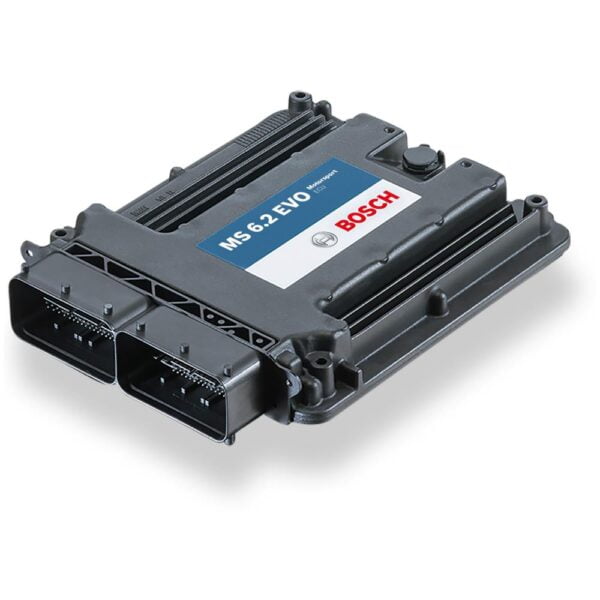
| MS 6.2 EVO | LP + LTE telemetry | 38 | 667 MHz | 4 GB |
| MS 6.3 EVO | LP + HP (GDI) | 21 | 667 MHz | 4 GB |
| MS 6.4 EVO | LP + HP (GDI) | 38 | 667 MHz | 4 GB |
| MS 6.4P EVO | LP + HP (GDI) | 38 | 866 MHz | 16 GB |
Accessories
- MSA-Box II — USB calibration interface for RaceCon
- WinDarab V7 — professional data analysis software (license key)
- Software Upgrade FULL_LOG_1 — 1,500 channels at 1,000 Hz (license key)
- Software Upgrade USB Data — USB data copy (license key)
- HPI5 Injection Power Stage — high-voltage GDI injector driver
- Lambda Sensor LSU 4.9 — wideband lambda for direct ECU input
- Knock Sensor KS4-R — engine block knock sensor
FAQ
What does the “P” in MS 6.4P stand for?
“P” indicates Performance — specifically the 866 MHz dual-core processor, which is approximately 30% faster than the 667 MHz CPU in all other MS 6 EVO variants. This additional processing headroom is intended for complex Customer Code Area (CCA) algorithms and for OEM programs where the MS 6.4P EVO is specified by series regulation.
Is the MS 6.4P EVO software compatible with MS 6.4 EVO software?
No. The MS 6.4P EVO requires a dedicated, separate software version in RaceCon. RaceCon project files from an MS 6.4 EVO installation cannot be directly loaded onto the MS 6.4P — migration to the dedicated MS 6.4P software branch is required. This is the most important practical difference between the two variants, and calibrators must confirm software availability before ordering.
Why does the MS 6.4P EVO have a larger memory upgrade?
The 16 GB optional memory expansion (vs 4 GB on other MS 6 EVO variants) reflects the intended use case: long endurance sessions with continuous high-rate logging. At 1,500 channels and 1,000 Hz, a standard 4 GB partition fills in approximately 40 minutes. The 16 GB expansion enables several hours of uninterrupted full-rate recording without partition switching.
Can I replace an MS 6.4 EVO with an MS 6.4P EVO?
Mechanically, yes — both use the same connector interface and chassis dimensions. However, you must migrate your RaceCon calibration project to the dedicated MS 6.4P software version. The hardware is a direct physical replacement; the software is not a drop-in replacement. Plan for a calibration migration session before deploying the 6.4P.
Does the MS 6.4P EVO include an internal IMU?
Yes. The MS 6.4P EVO includes a 6-axis internal acceleration sensor (X, Y, Z linear + pitch, roll, yaw), plus an internal ambient pressure sensor. These can be used for basic chassis dynamics monitoring or as reference inputs for CCA-based stability functions without additional external hardware.




Reviews
There are no reviews yet.