
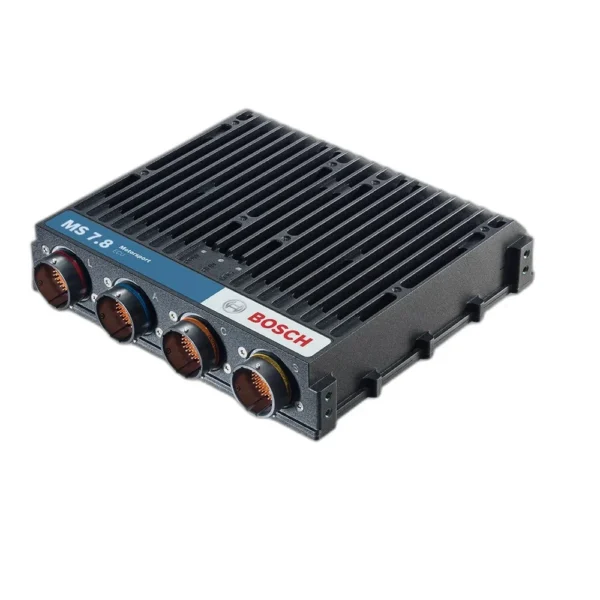
The Bosch Motorsport MS 7.8 manages gasoline engines up to 12 cylinders and is the top-specification unit in the Bosch Motorsport production ECU range. It runs in LMH class at the 24 Hours of Le Mans and GTP class at the Rolex 24 at Daytona — the two highest-profile endurance races in the world — where the complexity and reliability demands of hybrid powertrains, mixed-compound strategies, and race distances exceeding 24 hours define what an ECU must be capable of.
The defining hardware feature of the MS 7.8 is its eight fast cylinder pressure ADC inputs. These connect to piezoelectric in-cylinder pressure transducers mounted in the combustion chamber, providing crankangle-resolved pressure traces from each cylinder individually. Standard accelerometer-based knock sensors can only detect vibration propagated through the engine structure — with latency and cross-cylinder contamination. In-cylinder pressure measurement detects knock events at the point of origin, in the cylinder where they occur, enabling ignition timing to operate at the absolute edge of the knock limit without conservative safety margins across all cylinders simultaneously.
The five CAN channels (three of which support CAN-FD for higher bandwidth) and four Ethernet ports (one GBit plus three 100 Mbit) provide the network capacity required for the complex multi-device architectures of LMH and GTP hybrid systems — where ECU, VCU, hybrid controller, transmission ECU, ABS, and telemetry must all share data at high rates.
The MS 7.8 uses the same RaceCon calibration environment and WinDarab V7 data analysis tools as the rest of the Bosch Motorsport range. Software development for custom algorithms uses MATLAB/Simulink via the Customer Code Area.
Technical Specifications
| Property | Value |
|---|---|
| SKU | F02U.V03.249-01 |
| Engine type | Gasoline, up to 12 cylinders |
| Injection support | Low pressure (12 × 2.2 A) + high pressure (8 stages) |
| CPU | High-end FPGA + dual-core floating-point processor |
| Analog inputs | 46 |
| Cylinder pressure ADC inputs | 8 × fast ADC (piezoelectric in-cylinder pressure) |
| Thermocouple (EGT) inputs | 2 × K-type |
| Lambda interfaces | 2 × Bosch LSU 4.9 |
| Knock inputs | 4 |
| Sensor supplies | 8 × 400 mA (switchable 5 V/UBAT, with V and I sensing) |
| Sensor grounds | 8 + 2 sensor screens |
| Injector outputs LP | 12 × 2.2 A |
| Injector outputs HP | 8 × high-pressure stages |
| Ignition outputs | 12 × IGBT or BJT; 8 × 20 A integrated stages |
| Freely configurable outputs | 15 total: 2 × 8.5 A H-bridge, 2 × 4 A LS, 6 × 3 A LS, 4 × 2.2 A LS, 1 × 1 A LS |
| Total function outputs | 38 |
| CAN | 5 (3 × CAN-FD capable) |
| Ethernet | 1 × 1 Gbit + 3 × 100 Mbit |
| LIN | 1 |
| USB | 1 |
| Connectors | 4 × motorsport connectors, 264 pins total |
| Dimensions | 198 × 180 × 42 mm |
| Weight | 1,560 g |
| IP rating | IP67 |
| Supply voltage | 6 – 18 V |
| Calibration software | RaceCon |
| Data analysis | WinDarab V7 |
What You Can Do With It
- Detect knock events at individual cylinder level using in-cylinder pressure transducers — not vibration propagation through the block
- Calculate indicated mean effective pressure (IMEP) per cylinder in real time for combustion quality monitoring and power balancing
- Push ignition timing to the absolute knock limit independently per cylinder without conservative global safety margins
- Manage complex hybrid powertrain architectures with 5 CAN channels (3 CAN-FD) and 4 Ethernet ports
- Control port and direct injection simultaneously with 12 LP + 8 HP integrated injection stages
- Log all powertrain channels at high sample rates using the ECU’s integrated logging without a separate data logger
- Implement torque-based engine control architecture — arbitrating driver demand, traction control, gearshift management, and drivetrain protection in a unified torque model
- Deploy MATLAB/Simulink customer algorithms using the Customer Code Area for series-specific control strategies
Cylinder Pressure-Based Combustion Management
Standard knock detection uses accelerometers mounted on the engine block. Vibration caused by knock travels through the structure, arrives at the sensor with a delay, and contains contributions from all cylinders — making per-cylinder discrimination difficult at high rpm.
The MS 7.8’s eight fast cylinder pressure ADC inputs connect directly to piezoelectric transducers in the combustion chamber. Each cylinder’s pressure trace is available to the ECU in real time. This enables:
- Per-cylinder knock detection at crankangle resolution — not a block-average vibration level
- IMEP (indicated mean effective pressure) calculation per cylinder — direct measurement of combustion work output
- Pre-ignition and misfire detection from pressure trace shape
- Ignition timing at the combustion limit without conservative margins, because each cylinder’s knock state is known independently
Cylinder pressure combustion management is standard practice in LMH and GTP prototypes.
MS 7 Family Comparison
| Model | Analog Inputs | Cyl. Pressure ADC | CAN | CPU | Application |
|---|---|---|---|---|---|
| MS 7.4 | 41 | — | 3 | 1,000 MHz | GT3, endurance |
| MS 7.8 | 46 | 8 fast ADC | 5 (3 CAN-FD) | FPGA + FP | LMH, GTP prototype |
Accessories
- MSA-Box II — USB calibration interface for RaceCon
- WinDarab V7 — professional data analysis software (license key)
- Software Upgrade FULL_LOG_1 — 1,500 channels at 1,000 Hz (license key)
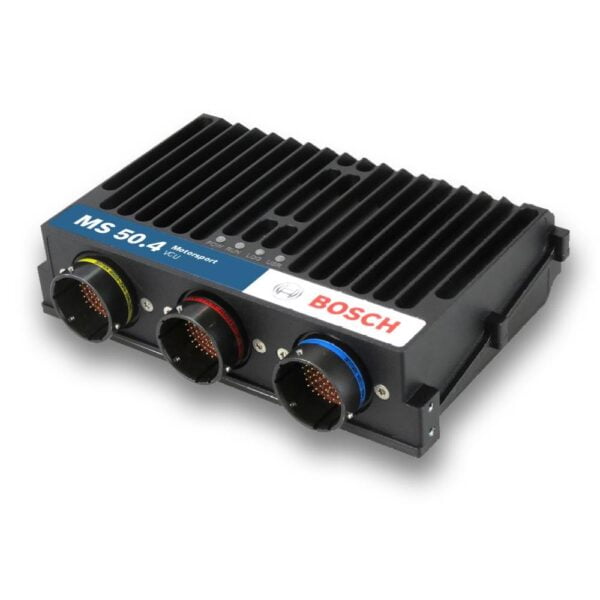
- VCU MS 50.4 — vehicle control unit for hybrid and dynamics integration
- HPI5 Injection Power Stage — high-voltage GDI injector driver
- Lambda Sensor LSU 4.9 — wideband lambda for direct ECU input
- MM7.10 IMU — 6-axis inertial measurement unit
FAQ
What is the difference between the MS 7.4 and MS 7.8?
Both use IP67 housings with four motorsport connectors on a 198 × 180 × 42 mm chassis. The MS 7.8 adds 8 fast cylinder pressure ADC inputs for in-cylinder combustion management — the key differentiator. It also has 5 CAN channels (3 CAN-FD) vs 3 CAN on the MS 7.4, four Ethernet ports vs three, and 46 analog inputs vs 41. The MS 7.8 is the ECU of choice for LMH and GTP prototype racing.
Does the MS 7.8 require cylinder pressure transducers?
No. The cylinder pressure ADC inputs are optional — the MS 7.8 operates normally without them using standard accelerometer-based knock sensors. The 8 fast ADC inputs become active when piezoelectric in-cylinder pressure transducers are installed. Many teams run the MS 7.8 in GT racing without cylinder pressure hardware and enable it later in their development programme.
What class of racing uses the MS 7.8?
The MS 7.8 is the ECU platform for LMH (Le Mans Hypercar) class at the 24 Hours of Le Mans and GTP class at the Rolex 24 at Daytona, as confirmed by Bosch Motorsport. It is also used in other top-level prototype and GT programmes where its processing and network capabilities are required.
Is the MS 7.8 calibrated with the same RaceCon software as the MS 7.4?
Yes. Both MS 7 variants use RaceCon for calibration and WinDarab V7 for data analysis. The MS 7.8 adds additional calibration parameters for cylinder pressure combustion management and CAN-FD configuration, but the core calibration environment and workflow are the same.
Does XTRA Motorsport supply the MS 7.8 as an authorised dealer?
Yes. XTRA Motorsport is an authorised Bosch Motorsport dealer. The MS 7.8 is available as a special order with typical lead time of 2–3 weeks. Our team has direct experience with the Bosch Motorsport product range and can advise on system integration, harness design, and software setup.

Reviews
There are no reviews yet.